If your drawers smell like a swamp and your ginseng tastes like angelica, the problem isn’t the herbs
Anyone who runs a TCM clinic knows the drill. Pull open a drawer, and last week’s astragalus has picked up the mint from two rows down. The codonopsis smells faintly of licorice. That is not a sourcing problem. That is a cabinet problem.
Wooden cabinets absorb moisture within two or three years. Herbs sit in those drawers like sponges in a sauna. Come monsoon season in Southeast Asia, or just a humid summer anywhere south of the Yangtze, mould beats you to work every morning. Cheap iron cabinets sound like a budget fix — until rust blooms along the edges in under eighteen months, bleeding orange stains onto herb packaging your patients can see.
I watched a community clinic pharmacist wipe down her drawer handles with a towel before every shift. She was not being fastidious. She was keeping rust off her hands. That kind of cabinet saves money on the purchase order and bleeds it back in wasted time, every single day.
Why Your Dispensary Needs a Cabinet That Does Not Absorb Problems
Storing Chinese herbs is nothing like stocking Western pharmaceuticals
Western meds come sealed — blister packs, foil wraps, airtight bottles. The environment barely touches them. Dried herbs are a different animal. They carry residual moisture activity. Put a bag of poria and a handful of mint in the same drawer, wait three days, and both have changed character. Not gone bad — just wrong. Subtly, irreversibly wrong.
Material absorption is the first domino. Wood breathes. What it breathes in — humidity, volatile oils from neighbouring herbs — it keeps. Drawer clearance is the second. When gaps exceed two millimetres, air moves freely between compartments. Free airflow equals free cross-contamination. The party wall between your astragalus and your angelica might as well not exist. Hardware is number three, though most buyers never flip a drawer over to check what the runners and handles are made of. Iron with chrome plating looks fine on a spec sheet. In a clinic where every surface gets wiped with alcohol three times a day, that plating comes off in months.
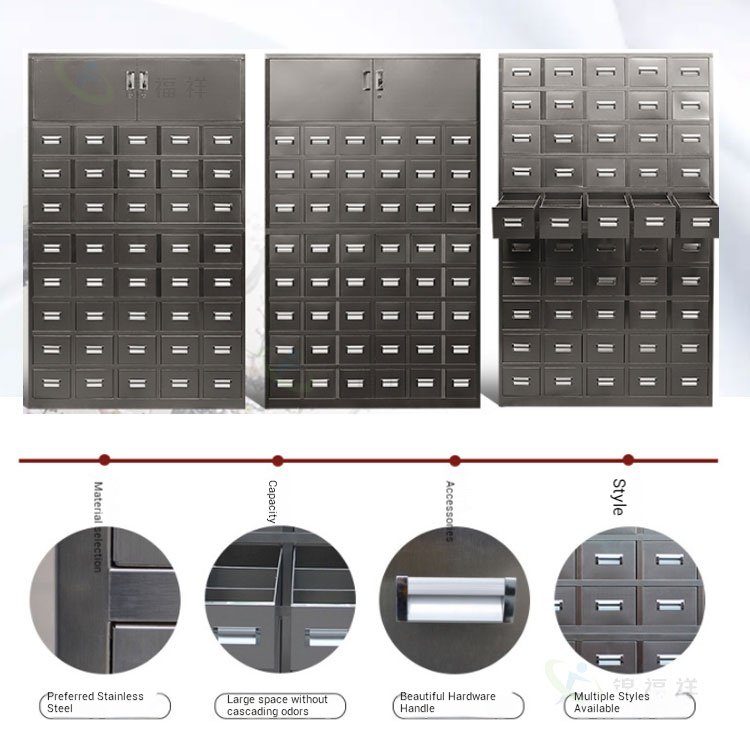
Stainless steel is the right call. 304 would be ideal — at nearly double the cost. A fully 304-gauge 48-drawer cabinet pushes your procurement budget up by forty percent or more. The question is whether your dispensary actually needs cold-room-grade steel. If your clinic is climate-controlled, dry, and ventilated — which it should be, for the herbs’ sake alone — 201 stainless covers the brief. This is not settling. This is matching the material to the working conditions instead of buying a label.
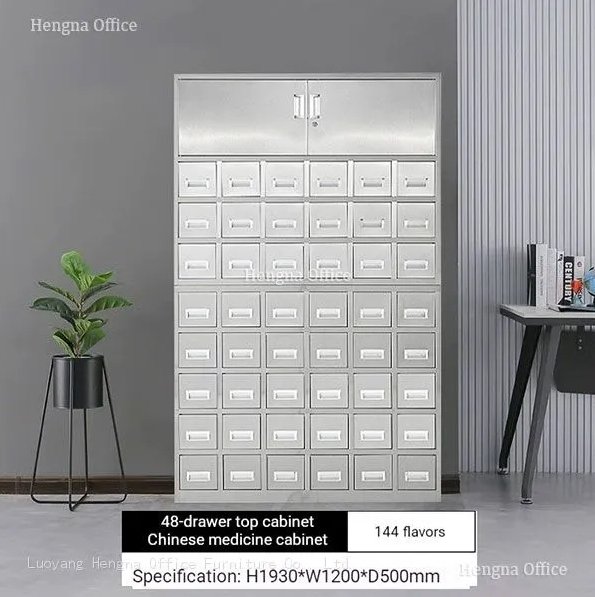
Hengna 48-Drawer Cabinet — Built for Daily Dispensary Work
What 201 stainless actually does inside a working pharmacy
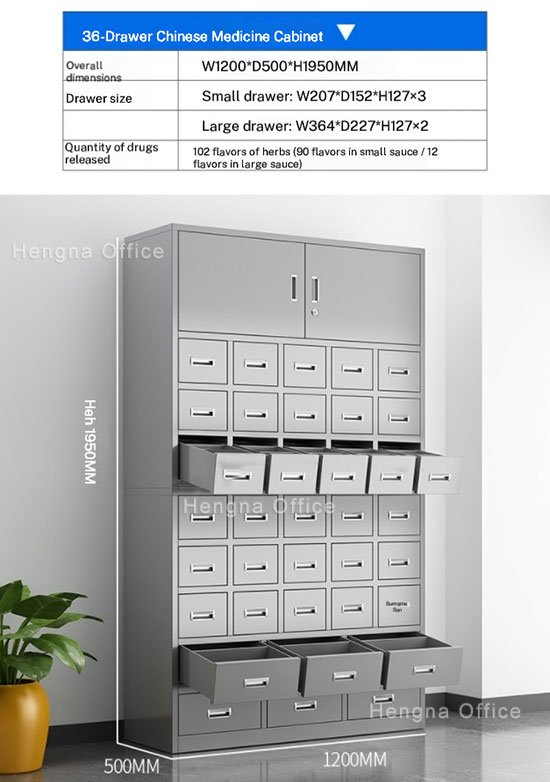
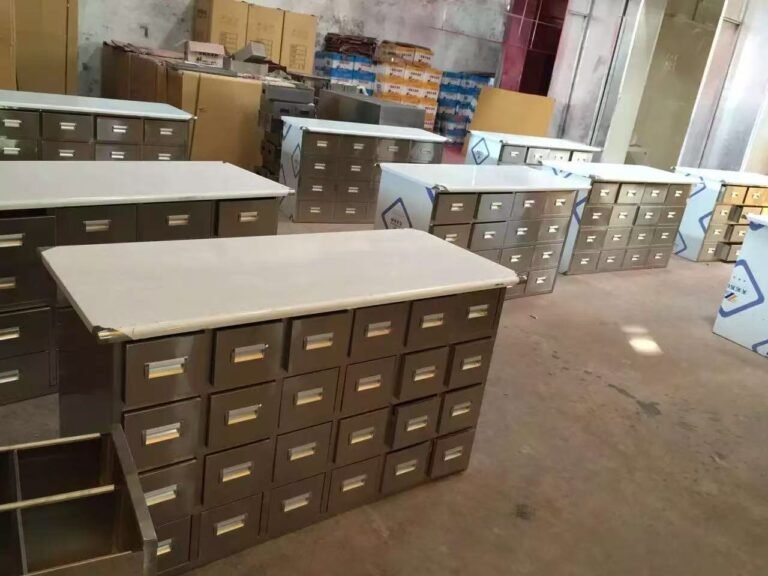
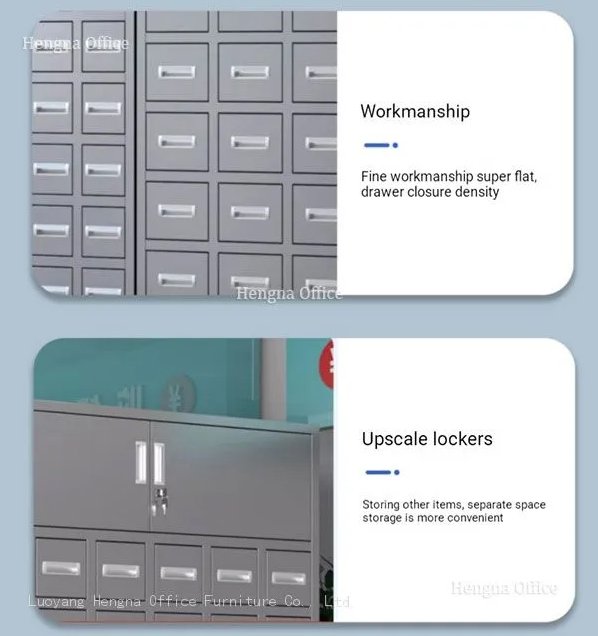
Hengna’s 48-drawer cabinet uses 201 stainless with a brushed finish. Brushed means something practical — no fingerprints. A pharmacist pulls drawers hundreds of times a shift. Matte steel does not broadcast every touch the way polished surfaces do. A dry cloth wipes it clean. Isopropyl alcohol straight from the spray bottle, no reaction.
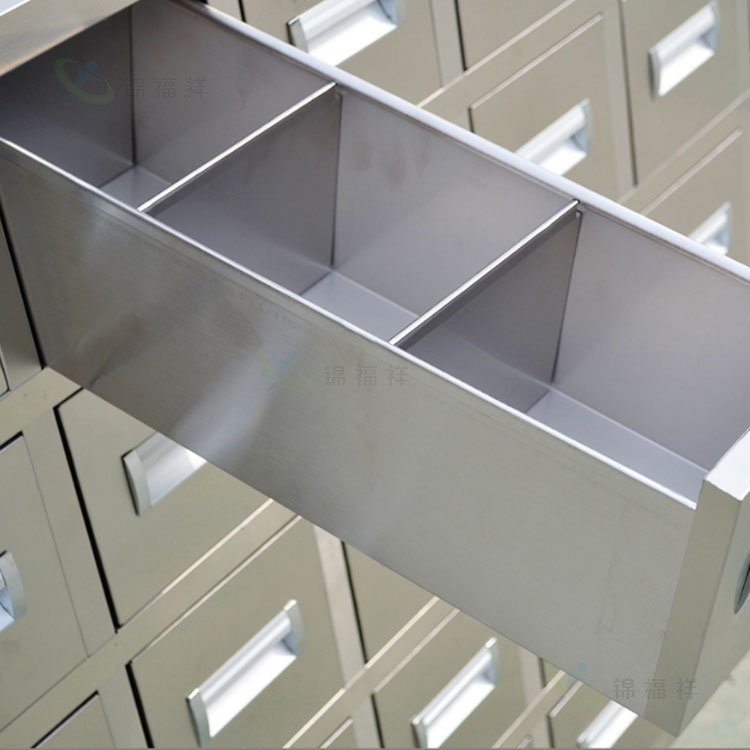
Forty-eight drawers. Three herbs each. One hundred forty-four varieties covered. Practising pharmacists know what that number means — a standard prescription formulary runs between one hundred and one hundred forty herbs. This cabinet covers the range in one footprint. Below the drawer bank sits a double-door storage compartment with a key lock. Decoction bags, bulk herb stock, scales, tools — lock it and walk away.
Fully assembled. Off the pallet, against the wall, open for business. Zero screws to turn.
Chinese Medicine Clinic Dispensary Moisture Proof 48 Drawer Key Specifications
| Spec | Detail |
|---|---|
| Overall dimensions | 1930mm H × 1200mm W × 500mm D |
| Drawer count | 48 independent drawers |
| Herb capacity | 144 varieties (3 partitioned slots per drawer) |
| Body material | 201 stainless steel, brushed finish |
| Drawer mechanism | Full-extension slides with internal dividers |
| Handles | Anodized aluminium |
| Base unit | Double-door locking storage cabinet |
| Build precision | Surface flatness ≤0.5mm, drawer gap <1mm |
| Shipping | Fully assembled — no assembly required |
Twelve hundred millimetres wide fits most standard clinic wall bays without eating into walking space. Five hundred millimetres deep swallows standard bulk herb packaging — no bags hanging out the front. The height lands at 1930mm. A pharmacist standing at this cabinet grabs herbs without bending at the waist and without reaching overhead. Eight hours on your feet, height matters for the spine as much as the workflow.
Questions Buyers Actually Ask
Does 201 stainless steel actually resist rust?
In a dry indoor clinic, absolutely. 201 stainless does not rely on a surface coating for corrosion resistance — the chromium and nickel in the alloy form a passive oxide layer at the molecular level. Keep it out of standing water and direct outdoor exposure, and it will not show rust in a decade of normal use. The conditions inside a Chinese medicine dispensary — room temperature, ventilated, dry — are exactly the operating environment 201-grade steel was designed for.
How do the drawers stay moisture-proof without rubber seals?
The material does the work. 201 stainless absorbs zero moisture and adsorbs zero odour — unlike wood. Drawer closure tolerance is held under one millimetre, tight enough that ambient humidity does not move freely into the compartment. Clinics in consistently humid regions — Guangdong, Fujian, anywhere tropical — typically add a silica gel pack per drawer and swap it every three months. The cabinet blocks what the material can block. The desiccant is a second layer, not a substitute. Rubber seals age and fail within a few years. Stainless steel does not have a shelf life.
Does this require professional installation?
It ships fully assembled. Remove the outer crate, two people lift it into position against the wall, done. Drawers come pre-mounted on their slides — factory-adjusted, ready to pull. The base cabinet lock is installed, keys are inside the drawer. No tools, no technician, no downtime.
There is no magic in a herb cabinet. It either works or it becomes the problem.
A good cabinet does three things for years without complaint: opens smoothly every time, keeps every herb tasting like itself, and refuses to rust. If it does those three, you forget it is there. That is the point.
Send your clinic’s wall dimensions if you are unsure about fit. I will tell you whether a 48-drawer unit slots in or whether you need a different layout. Returning it because it does not fit is more trouble than measuring first.