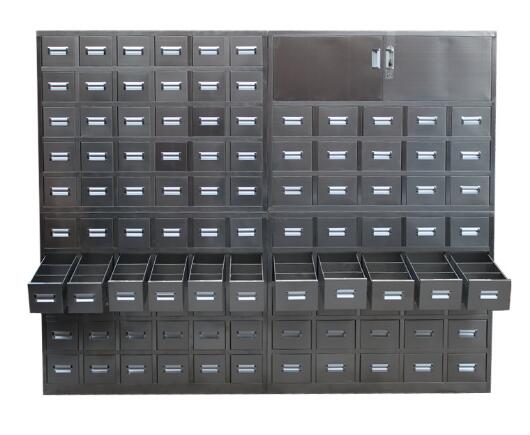
An acupuncture clinic is not a herb shop. The cabinet has to work around the beds.
Acupuncture clinics and Chinese herb shops occupy different worlds. A herb shop can line every wall with cabinets — patients stand and wait, space is secondary. An acupuncture clinic cannot. Treatment tables eat most of the floor. What remains is walking room, maybe a metre wide, and whatever fits against the wall without blocking the fire exit.
American acupuncture clinics range from forty to two hundred square metres, but the zone logic stays the same. Reception desk, three or four treatment tables, sterilisation area, herb section — all packed into one floor plan. If the herb cabinet runs wider than 1300mm, the aisle becomes a sideways shuffle. But you cannot cut herbs either — an acupuncturist prescribing herbal formulas needs access to a hundred-plus varieties, or you end up restocking every other week.
The physics here is simple: store what you need, take up as little floor as possible. When width is capped, go vertical. At 1930mm, this cabinet runs to just under a standard dropped ceiling — zero wasted overhead space. And every surface that faces the treatment area has to wipe clean in seconds. An acupuncture clinic holds itself to a higher hygiene standard than a back-room dispensary, and the furniture either keeps up or gets in the way.
How to Choose Storage That Works Inside an Acupuncture Practice
Four things matter. Everything else is noise.
One — will the width actually slot in. Measure the wall you are planning for, subtract the walking aisle, and what is left is your cabinet budget. 1200mm slots into most clinic wall bays without eating into circulation space. Wider, and you are trading workflow for storage — a bad deal in a room where people move around patients on tables.
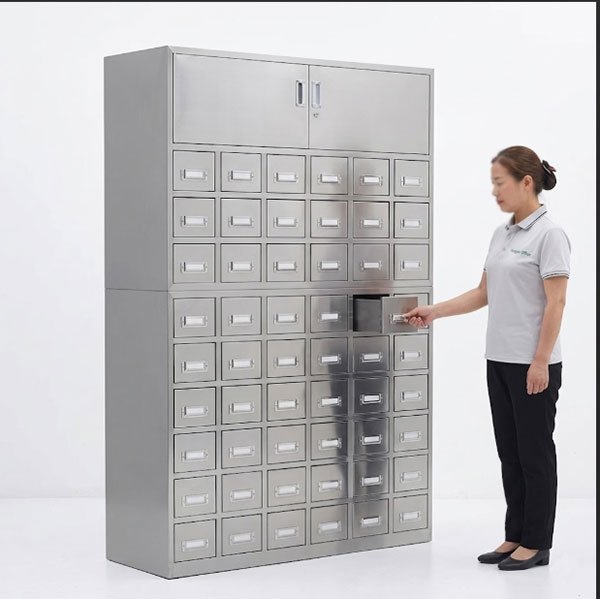
Two — do not leave height on the table. Standard clinic ceiling heights run 2400 to 2600mm. A cabinet topping out at 1930mm leaves roughly half a metre above. That gap is not dead space — it holds pulse pillows, moxa boxes, disposable bed sheets. Think of it as a built-in overhead shelf you did not have to install.
Three — depth has to match your herb packaging. Most wholesale herb bags come in at roughly 200mm by 300mm. A 500mm-deep drawer takes two rows standing upright, no stacking. Stacking flattens the bottom bags, hides the labels, and turns every refill into a rummage.
Four — the surface must forgive the cleaning routine. Acupuncture clinics disinfect treatment tables and worktops with alcohol multiple times a day. Your herb cabinet sits three or four metres from the treatment zone. It catches the same alcohol mist and the same moxa ash. A surface that wipes clean in one pass versus one that needs scrubbing — the gap looks small in a single shift and enormous across a year.
What Most First-Time Buyers Get Wrong
Three mistakes nobody tells you about until after the delivery.
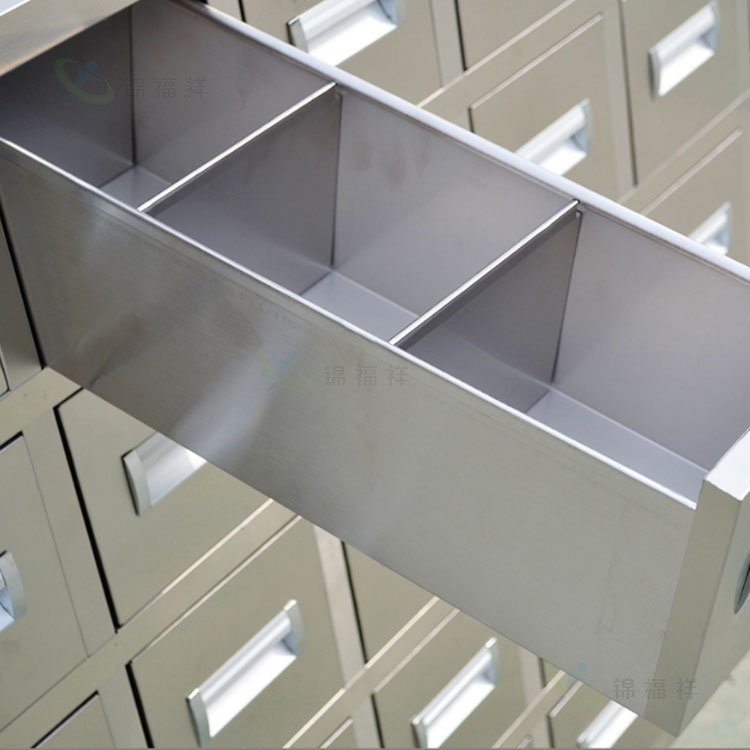
Mistake one — counting drawers instead of compartments. Forty-eight drawers sounds like plenty. But without internal dividers, you are fishing herbs out of a mixed pile every time you fill a prescription. Scutellaria and coptis are both yellow-brown. At speed, they look the same. Three divided slots per drawer means your hand goes straight to the target compartment. No fishing. No second-guessing. This is how a working pharmacist designs a cabinet — it is not a brochure feature.
Mistake two — chrome-plated iron handles. An acupuncture clinic disinfects at least three times a day. Chrome plating on iron does not survive rubbing alcohol. It blisters in under six months, peels before the year is out, then shows bare metal, then rust. Anodised aluminium handles cost marginally more — and the cost argument evaporates the first time you have to pay a handyman to swap out forty-eight degraded handles. Aluminium with anodising takes alcohol like water off a window. No reaction, no fade, no oxidation.
Mistake three — underestimating fully assembled delivery. Flat-pack cabinets look cheaper on the freight quote. Then you are on the floor with a hex key, drawer slides that bind if you are off by a millimetre, forty-eight drawers to tune one by one. Two people, a full day, maybe still not right. A fully assembled cabinet was levelled and adjusted at the factory before crating. Off the pallet, against the wall, drawers pull smooth from the first shift. An acupuncturist’s time costs more than an installation crew.
Acupuncture Clinic Herbal Pharmacy — Built to Fit, Built to Clean
Every design decision on this cabinet traces back to a real clinic constraint.
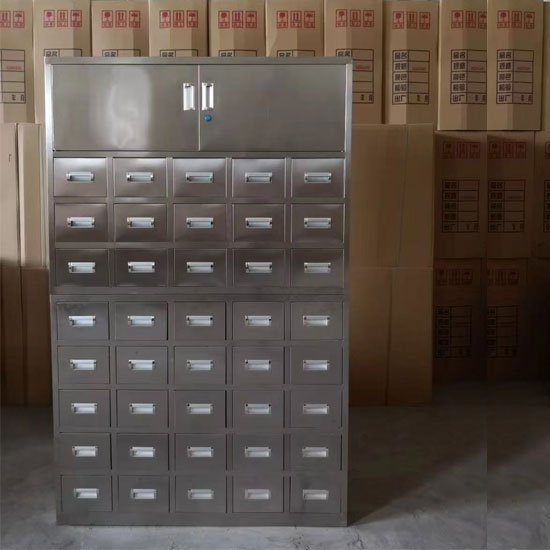
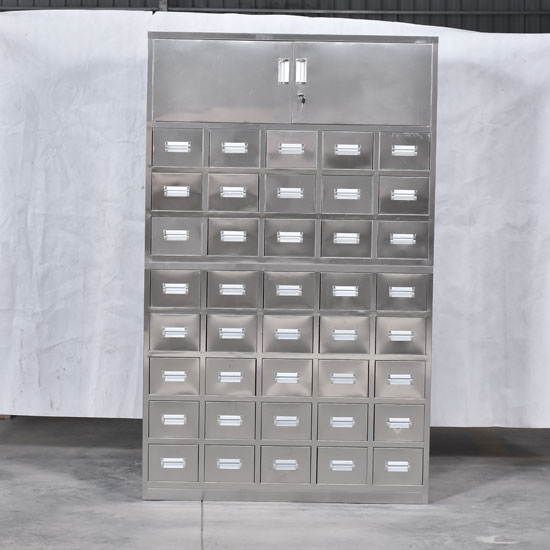
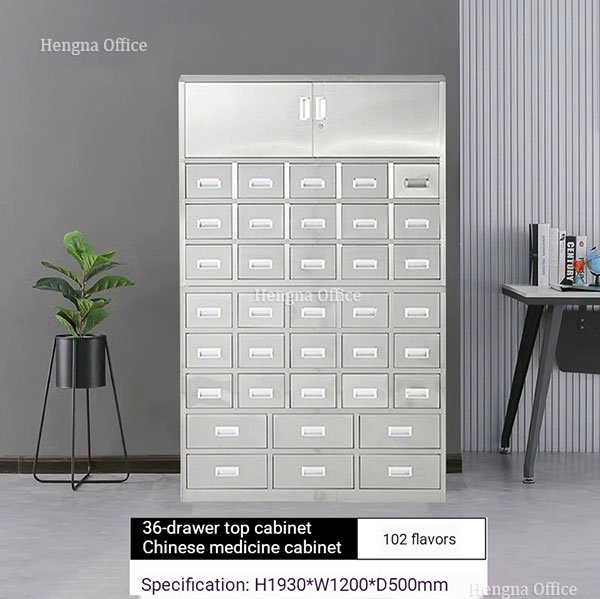
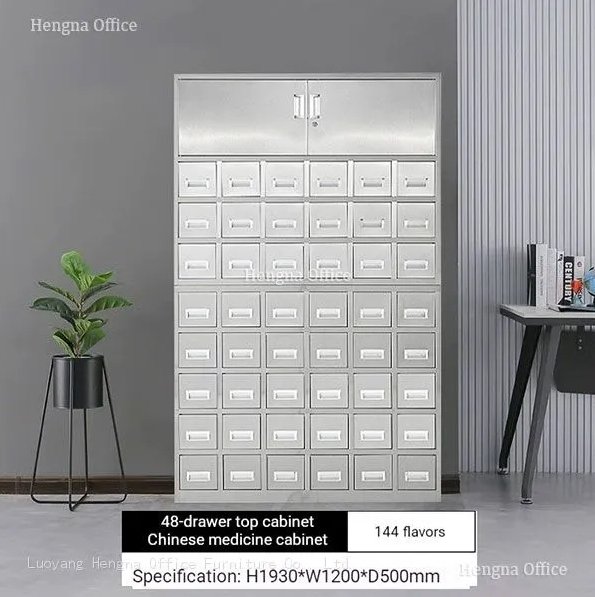
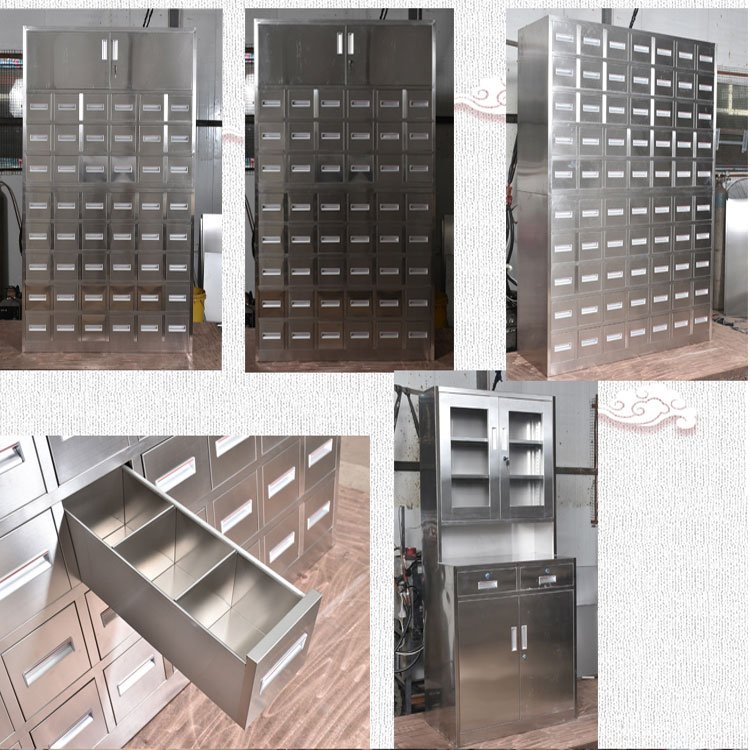
The width lands at 1200mm — slips into a standard clinic wall bay with room to walk past. Height at 1930mm puts the top row of drawers within an adult’s standing reach, no step stool, no bending at the waist. Depth at 500mm takes standard wholesale herb bags in two neat rows, labels facing forward, nothing crushed.
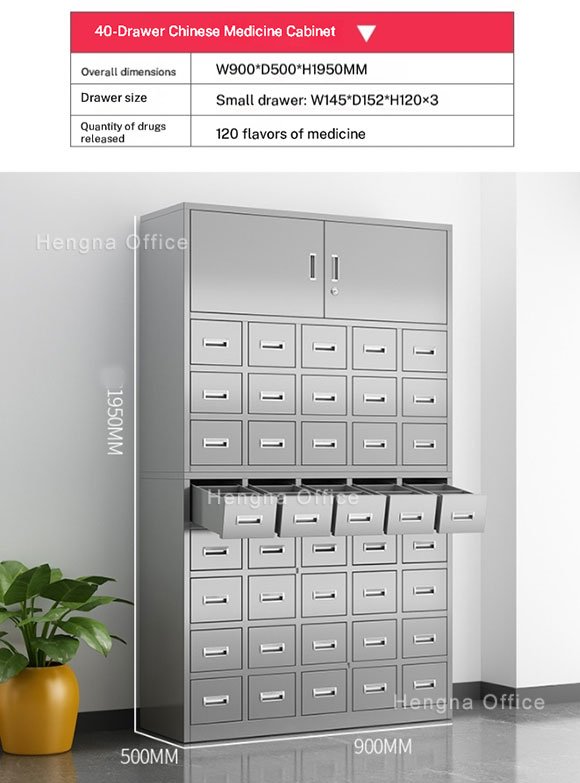
Full-extension drawer slides. Pull a drawer all the way out and the last compartment is as visible as the first — no craning your neck into a half-open gap. Three divided slots per drawer. Roots and rhizomes in one, flowers and leaves in the next, minerals in the third. Open the drawer, the layout tells you where everything is. Most herbal formulas follow a root-base, flower-blend, mineral-finish logic — the three-slot partition maps to how prescriptions actually get filled.
Above the drawer bank sits a double-door storage compartment with a key lock. Moxa rolls, cupping sets, acupuncture needles, decoction pouches — lock it and walk away. Clinics cannot leave supplies scattered across open shelving; health inspectors notice.
The surface is 201 stainless with a brushed finish. Isopropyl alcohol sprays on and wipes off — no oxidation, no discolouration. Moxa ash is dry plant residue; a dry cloth lifts it in one pass. The handles are anodised aluminium — warm to the touch, unlike cold stainless pulls, and alcohol-proof to the core.
Acupuncture Clinic Herbal Pharmacy Space Saving Vertical Cabinet Specifications at a Glance
| Spec | Detail |
|---|---|
| Dimensions | 1930 × 1200 × 500mm |
| Drawers | 48, each with 3 partitioned slots |
| Herb capacity | 144 varieties |
| Body material | 201 stainless steel, brushed finish |
| Handles | Anodised aluminium |
| Drawer slides | Full-extension |
| Upper storage | Double-door lockable cabinet |
| Shipping | Fully assembled — no installation |
Questions Acupuncturists Ask Before Buying
My clinic is tight on space. Is 1200mm still too wide?
The 1200mm figure is the cabinet’s external width. It sits against the wall and occupies wall length, not floor area. Most clinic walls run at least three metres — 1200mm takes up less than half that span. The remaining wall still fits a dispensing counter or a narrow utility cart. If your clinic is unusually narrow — think a converted brownstone in Manhattan with sub-two-metre wall sections — we suggest sending the wall measurement first. Custom narrow layouts are possible, but most clinics find the standard width slots straight in.
Can 201 stainless handle the alcohol and moxa exposure in a real acupuncture clinic?
Alcohol has zero effect on 201 stainless. The material does not rely on a coating — the alloy itself is inert to ethanol. Moxa ash is dry plant residue. It sweeps off with a dry cloth and contains nothing acidic that would corrode stainless. The only thing you must avoid is resting a still-burning moxa stick directly on the cabinet surface. That temperature will leave a mark on any material — it is a heat problem, not a steel problem.
What is the actual difference between this cabinet and a standard pharmacy herb cabinet?
Standard pharmacy cabinets run wider — 1500mm and up — because a back-room dispensary has no walkway constraint. They fill the space and stop. An acupuncture clinic cabinet runs a different equation: cover the formulary, stay out of the walking path, and clean up in seconds. If you select by pharmacy logic, you end up with a cabinet that fits the herbs but fights the room. Width and surface cleanability are the first two filters here — standard pharmacy units do not always pass either one.
There is no mystery to clinic storage. Three measurements and one routine.
A treatment table takes up so many metres. The walking aisle needs so many more. What is left is what the cabinet gets — and a well-designed 1200mm unit fits that number in the vast majority of clinics. The cabinet is not there to impress anyone. It is there to open smoothly, keep herbs where you left them, and disappear into the background of a clean room.
Send your wall measurement if you are unsure about fit. I will tell you whether the standard 1200mm slots in, or whether a custom width makes more sense.