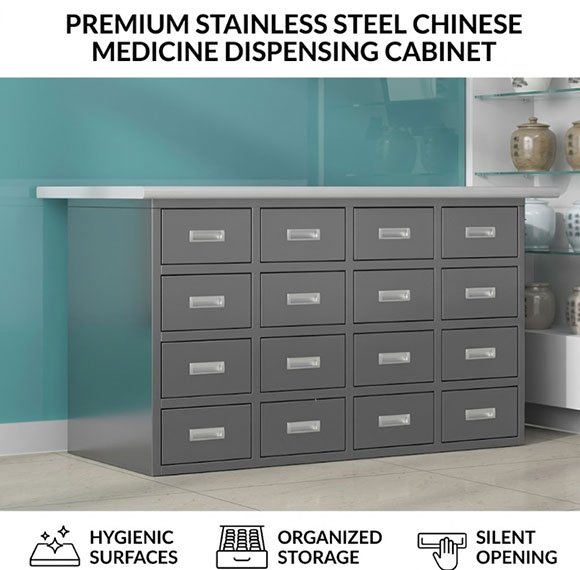
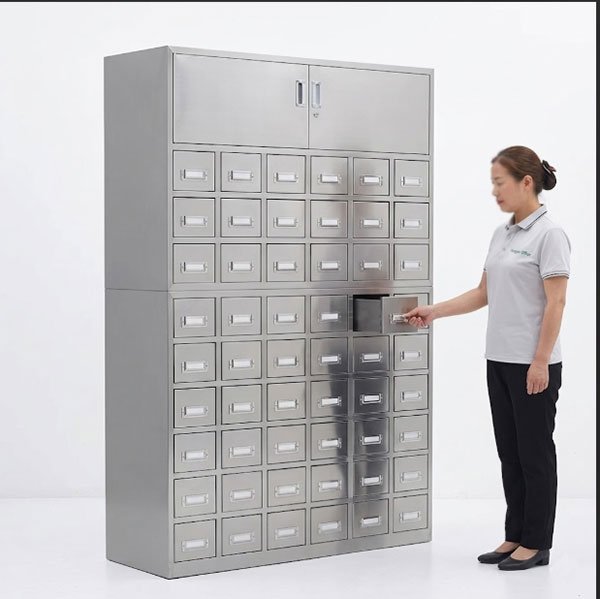
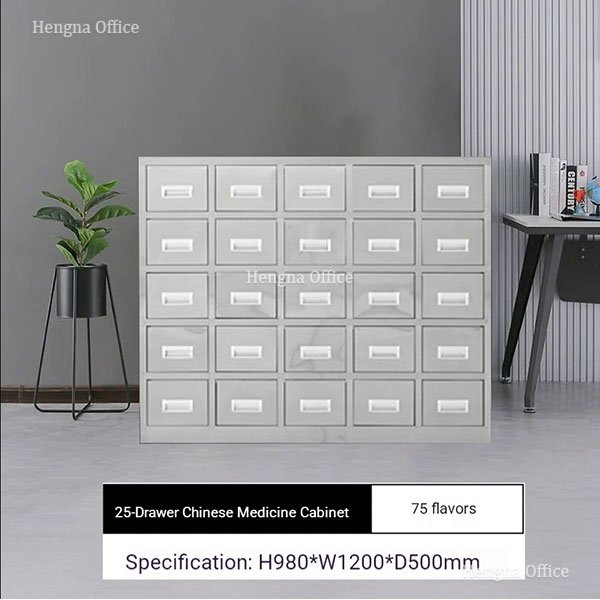
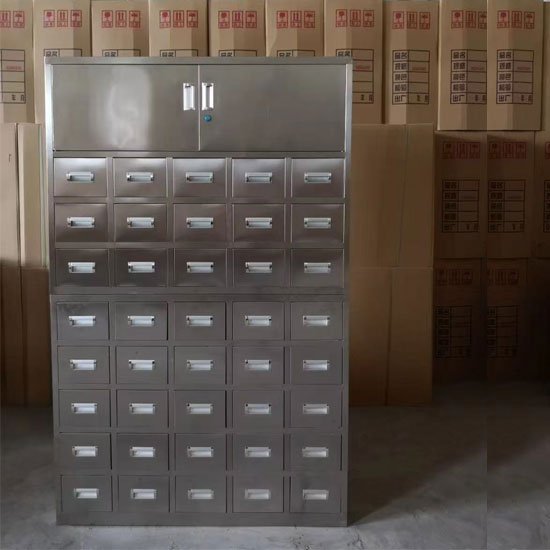
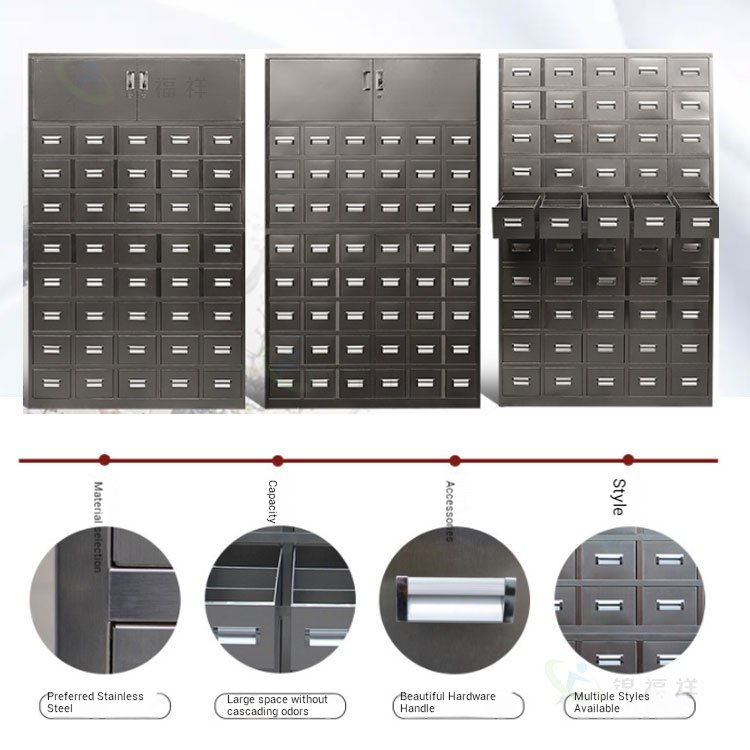
Every growing pharmacy hits the same wall — literally. The drawer wall fills up, the overflow moves to boxes behind the counter, and suddenly staff are dispensing from cardboard. The 210-compartment TCM cabinet is built for the moment that wall stops being enough: a 1.4-meter steel tower that holds a full working pharmacopoeia in two square meters of floor.
This article covers what 210 compartments actually holds, who genuinely needs that capacity, and how to plan the floor space so a cabinet this size works with your room instead of against it.
What 210 Compartments Actually Holds
Start with the inventory math. A typical TCM pharmacy carries:
- Core prescriptions staples: 80–120 herbs that appear in most prescriptions every day
- Seasonal and specialty items: 40–80 herbs rotated by demand
- Rare or premium stock: 20–50 items kept in smaller quantities
- Powders, granules, and prepared medicines: 20–40 lines
That is a working range of 160–290 distinct items — exactly the band a 210-compartment cabinet covers. One herb per compartment, with dividers splitting busy drawers into two or three slots, and a single tower absorbs the inventory that used to sprawl across a wall of small cabinets and a back-room shelf.
Who Needs High-Volume Storage
Not every buyer needs 210 compartments, and ordering too big wastes wall space. This size fits:
- Hospital TCM departments — where dispensing volume and herb variety both run high, and floor plans favor one tall unit over a row of short ones
- Established retail pharmacies that already carry 200+ lines and keep adding seasonal stock
- Wholesale and distribution counters that pick stock for smaller clinics
- Teaching dispensaries that maintain a full materia medica for student practice
A solo practitioner running 80 herbs should stop reading and order a 36-drawer unit instead — the extra compartments would sit empty for years.
One Tower vs Several Small Cabinets
When capacity is the same, the choice between one tall cabinet and a row of short ones changes daily workflow:
| Factor | One 1.4m Tower (210 compartments) | Several Short Cabinets |
|---|---|---|
| Floor space | About 2 m² of wall, one footprint | Same capacity but spread along more wall |
| Walking per prescription | One vertical sweep, top to bottom | Multiple stops across the room |
| Label scanning | Rows stack in a predictable grid | Each cabinet breaks the pattern |
| Expansion | Add a matching tower beside it | Mismatched units accumulate |
| Cleaning | One unit, one routine | Several surfaces, more time |
Built to Carry the Load
A cabinet holding 210 filled compartments is a heavy piece of furniture before a single herb goes in. The construction has to match:
- Full steel body. Cold-rolled steel frame and panels carry the static load without flexing; powder coating resists the daily knocks of a busy dispensary.
- Ball-bearing slides throughout. Every drawer opens smoothly at full extension, even loaded with dense roots and minerals.
- Even weight distribution. The tall grid spreads drawer loads down the frame instead of concentrating them at the base.
- Lockable top section. The most premium or restricted items sit behind a lock at the top — visible, secure, and away from casual reach.

Fitting a 1.4m Cabinet Into Your Floor Plan
The cabinet stands 1.4 meters wide and reaches full height, so plan the placement before ordering:
- Wall run: allow 1.5 meters of clear wall — the cabinet plus breathing room at each end for cleaning.
- Depth check: confirm the depth against your aisle; staff need room to open deep drawers fully and step back with a tray.
- Door and corridor path: measure every doorway between the delivery truck and the final wall. A fully welded tall unit cannot turn corners that a flat-pack would.
- Anchor point: in earthquake-prone regions or clinics with children, ask about anti-tip fixing to the wall.

Filling 210 Compartments Without Chaos
Capacity is only an asset if it is stocked deliberately. A filling plan that works for most dispensaries:
- Stock the core first. Load the 80–120 prescription staples at eye level before anything else — the cabinet earns its keep from the first week with these alone.
- Hold two rows empty. Reserve a middle band for the seasonal stock that arrives over the next quarter. A cabinet filled wall-to-wall on day one has nowhere to put the next delivery.
- Duplicate the bestsellers. Two or three ultra-high-turnover herbs deserve a second compartment — a backup slot means the queue never waits on a refill.
- Photograph the finished wall. A full-grid reference photo turns staff training and restock verification into a ten-second check.
Dispensaries that skip the plan spend the first month reshuffling. The plan takes one afternoon and never needs redoing.
A Drawer Layout That Scales
Capacity only pays off when the grid is organized. The layout that works for most high-volume dispensaries:
- Eye-level rows: the 30–40 herbs that appear in half of all prescriptions. Zero bending, zero reaching.
- Upper rows: lighter, slower-moving items — flowers, processed powders, seasonal stock.
- Lower rows: heavy minerals and bulk roots, where the drawer weight is easiest to pull.
- Top lockable section: restricted items and high-value stock.
Label every compartment on day one, group by function class or pinyin — and hold the line every time stock moves. The grid only saves time if it stays true.
FAQ
How many herbs fit per compartment?
A standard compartment holds one herb line in working quantity. With dividers, busy rows become two or three slots — so 210 physical compartments can organize 250–300 distinct items.
Is a cabinet this tall stable?
Yes — the steel frame is welded as one unit and the weight sits low in the drawer grid. For extra safety on uneven floors, anti-tip wall fixings are available.
Can I get it in stainless steel instead of powder-coated steel?
Yes. Powder-coated cold-rolled steel suits most inland clinics; 201 stainless handles humid interiors; 304 is the coastal and heavy-disinfectant choice.
What is the lead time?
Standard configurations ship from stock. Custom colors, sizes, or compartment layouts run two to four weeks in production before freight.
How does restocking work with this many compartments?
Refill on sight — any drawer running low is flagged the moment it opens. Most dispensaries restock from bulk shelving in the back room on a fixed weekly round.
Can the cabinet be split into labeled zones for different formula families?
Yes, and most high-volume pharmacies do. Common splits run by function class, by dosage form (raw herbs versus powders), or by prescription frequency — the grid accepts any system, as long as one system holds the whole wall.
Is a tall cabinet harder to keep organized than a wide one?
No — taller just means more vertical zones. Dispensaries actually find tall grids easier to zone: eye level for staples, top for light stock, bottom for heavy drawers. The labeling discipline matters far more than the cabinet’s shape.
What maintenance does a cabinet this size need?
Less than its footprint suggests. Weekly wipe-down of drawer faces, a damp cloth across empty drawers during restock, and a twice-yearly check of the slides. The steel body does not need oiling, sealing, or refinishing at any point in its life.
Capacity That Pays for Itself
A 210-compartment cabinet is not about owning the biggest cabinet — it is about ending overflow for good. One tower, one footprint, one labeling system, and a wall that still has room next year. If your herb list is past 150 lines and climbing, this is the size that ends the problem instead of postponing it.
Compare sizes in our steel herbal storage cabinet range, or read how to choose the right drawer size before ordering.