Ask a pharmacist what slows a clinic down and the answer is rarely knowledge or hands — it is steps. Steps between the prescription and the scale. Steps to the back shelf. Steps to find a jar someone refilled in the wrong place. The herbal dispensing counter exists to remove those steps: one station where reading, reaching, weighing, and packing happen in a single standing position.
This guide explains what a dispensing counter actually does for a TCM clinic, how to set one up so it carries the whole workflow, and how to size the setup to your patient volume.
The Counter Is Where the Clinic Works
Watch any efficient dispensary and you will see the pattern: everything important happens at one bench. The prescription is read there. Herbs are pulled there. The scale, the packing paper, the label printer — all within one arm’s arc. Storage surrounds the bench; the bench itself stays clear for work.
Clinics that scatter these jobs across the room pay for it all day. A counter-based station collapses each prescription into a short loop: read, pull, weigh, pack, hand over. Fifty loops a day at ten saved steps each is a walk across a football field — gone.
What a Dispensing Counter Does That Cabinets Cannot
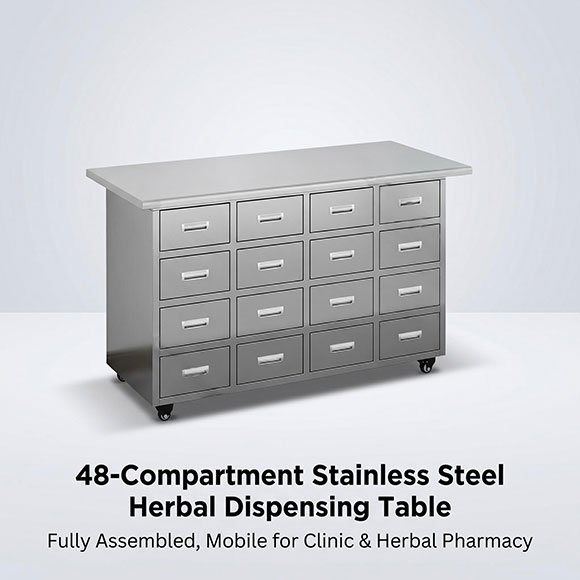
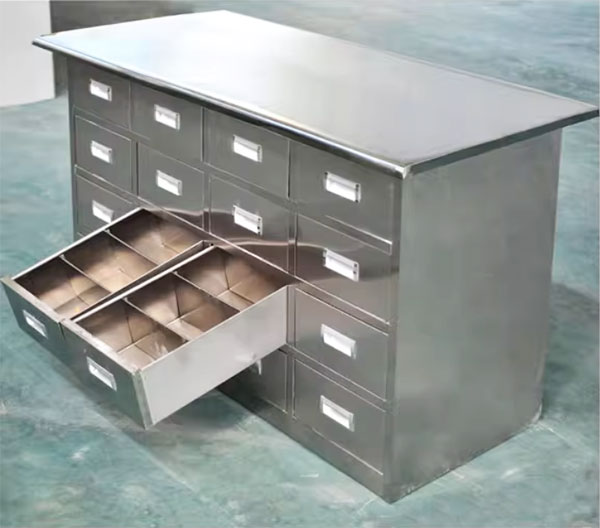
Cabinets store. Counters work. A proper dispensing counter combines four jobs in one unit:
- Work surface. A stainless top at standing height for weighing, dividing, and packing prescriptions.
- Daily-use storage. Drawers directly beneath the surface hold the herbs staff reach for hour by hour.
- Labeling system. Slots on every drawer face keep the grid readable from a standing position.
- Hygiene station. A non-porous surface that takes a disinfectant wipe between prescriptions — something no wooden bench offers.
A clinic can run on cabinets alone, but then weighing happens on a borrowed surface, powder dust lands where herbs will sit tomorrow, and staff walk. The counter is the piece that makes the rest of the room make sense.
Anatomy of a Working Counter
Not every counter earns its floor space. The features that matter in daily use:
- One-piece stainless surface. No seams means no trapped herb dust and no stained joints. 201 stainless handles daily disinfectant without dulling.
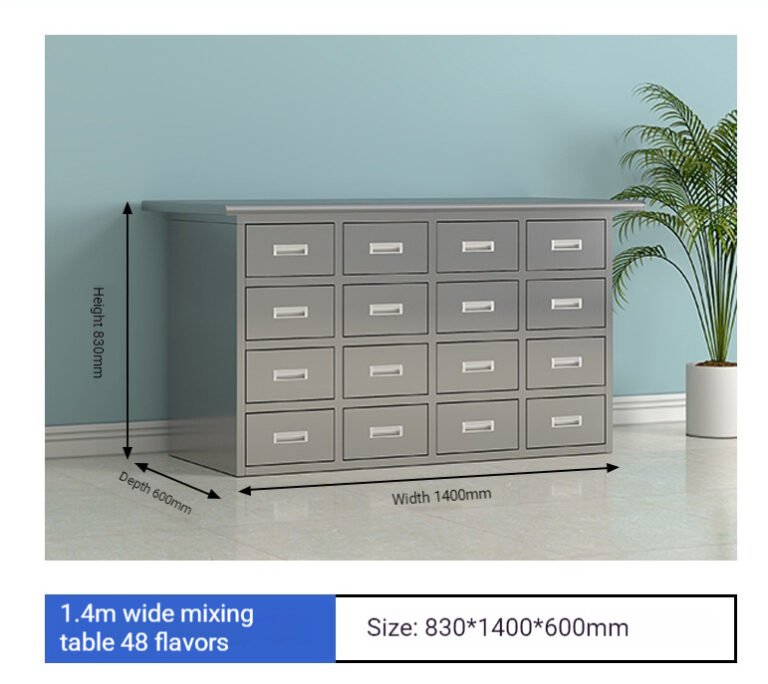
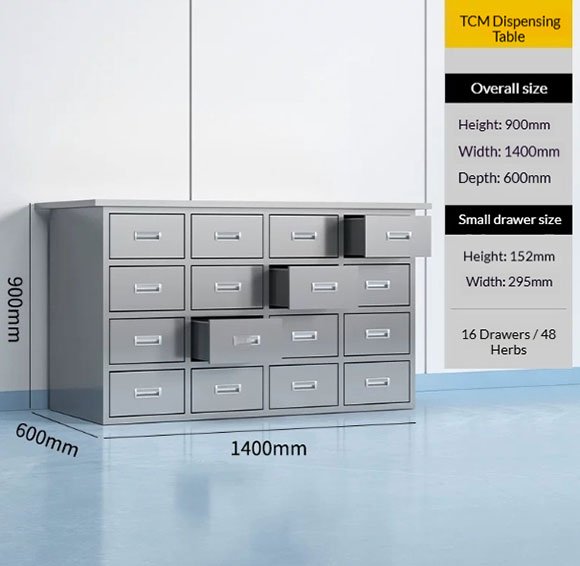
- Working height. Around 90 cm suits standing staff; lower counters turn every weighing session into a backache.
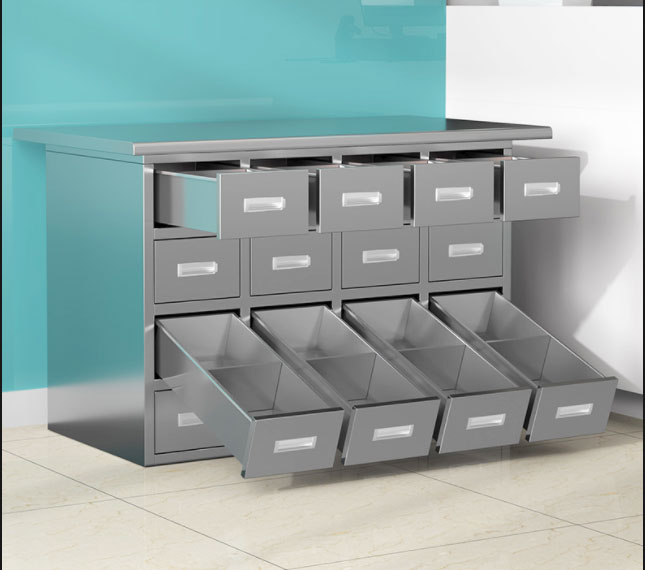
- Drawers sized for herbs, not paperwork. Look for 120 mm-plus interior depth for roots and barks, with dividers for small-batch items.
- Ball-bearing slides. A loaded drawer should glide open with one hand while the other holds the prescription.
- Label slots, not stickers. Card labels survive humid rooms; adhesive curls and fades.
Setting Up the Station: A Five-Step Layout
A counter organizes a dispensary only if the layout is deliberate. The setup that works in most clinics:
- Fix the counter’s position. Back to the wall, drawers facing the staff side, patients at the front. Once set, brake any casters — a moving counter is a spill.
- Load by frequency. The twelve busiest herbs go in the front row. If staff touch an herb hourly, it belongs within one step.
- Fix the scale’s home. One end of the surface, permanently. Packing paper and bags beside it. The loop only gets fast when every tool has an address.
- Label before stock. Write and slot every label before the drawers fill. Retro-labeling is how layouts drift.
- Assign the reset. One person, end of day, two minutes: surface wiped, scale zeroed, any misfiled drawer returned. A station that resets daily stays organized for years.
How Many Counters Does Your Clinic Need?
Counter count follows prescription volume — not staff count:
| Daily Prescriptions | Typical Setup | Why |
|---|---|---|
| Up to 30 | One 16-drawer counter | One dispenser covers the flow; drawers hold the working herb list |
| 30–80 | One counter + wall cabinet behind | Counter for daily herbs, cabinet for the full inventory |
| 80–150 | Two counters in an L or row | Two dispensers work without crossing paths |
| 150+ | Counter row + dedicated bulk store | Industrial volume needs industrial layout |

Common Counter Mistakes to Avoid
Most inefficient stations were set up with good intentions. The four mistakes that show up again and again:
- Overloading the top. Piling equipment and stock boxes on the surface leaves no room to actually work. If the surface hosts more than the scale and packing paper, the counter is doing storage’s job — and badly.
- Random drawer growth. Herbs added wherever an empty slot happens to be. Six months later the grid reads like a scavenger hunt. New herbs get a planned slot or they wait.
- Skipping the labels. One unlabeled drawer becomes two, then ten. The label slots exist to be used on day one.
- Ignoring the aisle. A counter pushed too close to the wall or shelving opposite means drawers that open halfway. Measure the standing aisle before the counter goes in.
Hygiene and the Daily Reset
Herbs are food-adjacent medicine, and the counter is where they are handled most. The hygiene routine is short but non-negotiable:
- Wipe the surface between prescription batches — dry cloth for dust, damp for residue.
- Disinfect once at closing; 201 stainless tolerates clinic-grade solutions without staining.
- Line powder drawers with food-grade paper and change liners on refill.
- Deep-clean emptied drawers on rotation rather than all at once — a drawer out of service for an hour costs nothing.
FAQ
Counter or cabinet — which should a small clinic buy first?
The counter. It combines storage, work surface, and hygiene in one footprint. Add a tall cabinet when the herb list outgrows the drawers, not before.
Can two dispensers share one counter?
Up to a point. Two staff fit at a 1.4-meter surface if they work opposite ends, but prescriptions queue fast past 80 a day — that is when a second counter pays for itself.
What width counter fits a small treatment room?
Compact counters start around 1 meter. Measure the wall, leave 90 centimeters of standing aisle in front, and check the delivery path before ordering.
Do counters come with casters?
Caster versions are available for clinics that clean under furniture or reposition seasonally. Choose brakes as standard — a counter must not move mid-weigh.
How does a counter handle powder herbs?
Well, with liners. Sealed steel drawers contain dust; food-grade paper liners make refills and drawer changes a ten-second job.
Can the counter take a label printer and bag sealer on top?
Yes — that is the intended workflow. Keep the stainless surface for weighing and packing tools, and move bulk stock storage to the drawers and cabinets. If the counter top hosts heavy fixed equipment, mention it when ordering so the frame is reinforced.
What is the first sign a counter layout needs rework?
Staff leaving the station mid-prescription. If the loop breaks — a trip to a shelf, a walk to the scale, a hunt for bags — the layout has drifted. Walk one prescription with a staff member and you will find the fix inside five minutes.
One Station, Whole System
A dispensing counter is not furniture — it is the operating table of the dispensary. Give it the right height, the right drawers, and a five-step layout, and every prescription that crosses it gets faster. Start with one counter sized to your daily volume, organize it deliberately, and let the rest of the room arrange itself around the work.
Browse the full range of steel herbal dispensing counters, or read our guide to choosing the right drawer size before ordering.