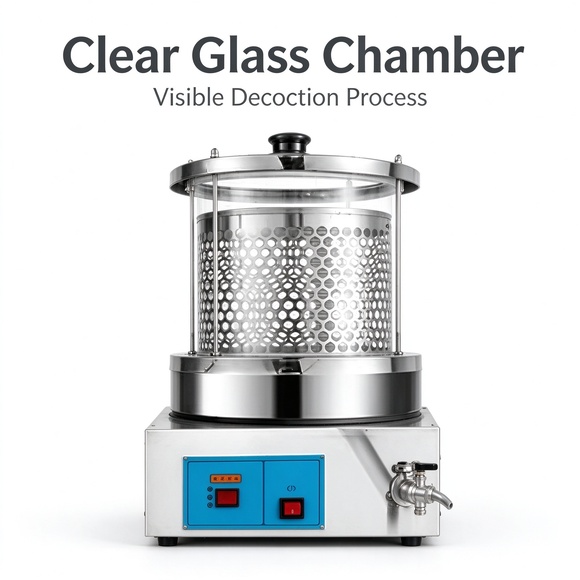
A pharmacy that dispenses herbs but sends patients home to boil them is handing away half the experience. Decoction is where herbal medicine becomes medicine — and it is the messiest, most time-bound step in the chain. A TCM decoction machine moves that step behind your own counter, on your schedule, at your standard.
The single-cylinder 20L model is the entry point for clinics adding in-house decoction: one stainless vessel, digital control, and enough capacity to process a working queue of prescriptions. This article explains where the machine fits in the clinic workflow, what 20L means for a real day, and how to run and clean it.
Where the Machine Fits in the Clinic Chain
Herbal service is a four-step chain, and the machine plugs directly into the last two links:
- Prescribe — practitioner writes the formula
- Dispense — staff pull and weigh herbs at the counter
- Decoct — the machine brews the prescription to a controlled standard
- Pack — the dose is sealed into bags or bottles for the patient
Without step three in-house, patients take home raw bundles and a set of hopefully-remembered boiling instructions. Compliance drops; results get blamed on the herbs; the clinic’s role ends at the counter. With a machine, the clinic hands over a finished, labeled, ready-to-drink product — and controls the one variable patients were most likely to get wrong.
What 20L Actually Means for a Working Day
Cylinder volume translates into prescriptions per cycle, and the practical math runs like this:
- A single oral prescription typically brews into a one-to-two liter working batch after soaking and simmering
- A 20L cylinder processes several prescriptions per cycle, or one large multi-day batch for a single patient
- Cycles stack through the day: soak in the morning, brew through the afternoon, pack as batches finish
For a clinic dispensing a few dozen prescriptions a day, one 20L cylinder running alongside normal counter work keeps pace. The moment decoction demand outruns the cylinder — usually visible within the first month — a second unit or a larger multi-cylinder setup slots beside it.
The Digital Control Cycle
Stovetop decoction depends on whoever is watching the pot. A digital machine replaces attention with a program:
- Load and soak. Herbs go into the stainless cylinder with water; soaking before heating is the step home brewers most often skip.
- Programmed boil. The machine brings the batch to a full boil under control — no scorched bottoms, no boil-overs.
- Simmer phase. Heat drops and holds for the simmer period the formula requires, without someone standing over it.
- Hold and dispense. The finished decoction holds at a safe temperature until staff pack it — no reheating, no waiting at the stove.
The practical difference shows up in consistency: the same formula decocted on Monday and Friday comes out the same, which is exactly what patients are paying for.

Single Cylinder vs Multi-Cylinder Setups
One machine is a start; the right topology depends on volume and formula mix:
| Setup | Best For | Watch Out For |
|---|---|---|
| Single 20L cylinder | Clinics starting decoction service; steady daily volume | Queue delays when many prescriptions finish at once |
| Two or more cylinders | Higher volume; formulas with very different simmer profiles | Floor space and power planning |
| Machine + packing unit | Clinics sealing doses in bags for take-home | Connecting the workflow between brew and pack |
Most clinics that start with one cylinder add a packing machine within the first year — brewing and bagging are a natural pair, and the pairing is what turns decoction from a favor into a service line.
Fitting the Machine Into the Room
A decoction machine needs three things from the room, and it is cheaper to plan them than to retrofit them:
- Power. Heating elements draw serious current — confirm the circuit with the supplier’s spec sheet before installation day, not after the breaker trips.
- Water access. Near a tap or a dedicated fill point; carrying cylinders of water across the clinic is a routine that will not survive its first week.
- Ventilation and drainage. Steam and spills are part of brewing. A floor drain nearby and airflow out of the room keep the space workable — placing the machine in a corner with no airflow is the most common regret.
Position the machine close to the dispensing counter: the shortest path between pulled herbs and the cylinder is the same workflow logic that runs the rest of the clinic.
Cleaning and Maintenance
Herbal decoction leaves oils and residues that matter for the next batch. The routine:
- Drain and rinse after each cycle. The stainless cylinder wipes clean in minutes while still warm.
- Daily full drain. Never leave decoction sitting overnight — flavor transfer and hygiene both suffer.
- Weekly deep clean. A food-safe descaling pass keeps the element and cylinder interior performing.
- Check gaskets and valves monthly. Seals are the only wearable parts on a well-built unit.

FAQ
How many prescriptions can a 20L machine process per day?
It depends on batch size and how cycles stack, but a single cylinder comfortably supports a clinic dispensing a few dozen prescriptions daily. Track your queue for two weeks — if decoction demand backs up, add a second cylinder.
Does machine decoction taste different from stovetop?
Done correctly, no — the machine removes human variance, not flavor. Consistent soak, boil, and simmer phases actually make batches more uniform than stovetop brewing.
Can strong-smelling formulas run before delicate ones?
Plan strong or aromatic formulas late in the day, or dedicate a cleaning cycle between very different prescriptions. The stainless cylinder rinses clean quickly between batches.
What power supply does the machine need?
Specifications vary by model and region — confirm voltage and circuit requirements with the supplier before installation so the clinic’s wiring matches.
Is training required to run it?
The digital panel is straightforward: load, select the program, start. Staff learn the full cycle in a day; the supplier’s manual covers program settings for different formula types.
What do patients ask about machine-brewed medicine?
Mostly two things: whether it is the same as boiling at home, and whether their formula is brewed alone. The honest answers — consistent phases, one prescription per cylinder load, cleaning between batches — are exactly why the machine improves the service. Clinics that train staff to answer these two questions turn a piece of equipment into a selling point.
Can the machine handle honey-fried or processed herbs?
Processed materials brew fine in a machine cycle — the programmable phases actually help here, since honey-fried and wine-processed herbs respond better to controlled heat than an unattended stove. Very resinous materials may need a shorter soak; the supplier’s program guide covers the common cases.
Where should the machine sit relative to the dispensing counter?
Within a few steps, on the same side of the room as the counter’s working face. The loop is: pull herbs, hand off to the cylinder, return to the counter. Every extra meter between machine and counter is repeated for every prescription the clinic decocts — position it like the scale, not like a storage cabinet.
The Last Step Belongs in Your Clinic
Every prescription leaves the clinic with a promise attached. A decoction machine lets you keep the whole promise — prescribed, dispensed, brewed, and packed under one roof, at one standard. For clinics ready to close that gap, a single-cylinder 20L unit is the practical first machine.
Browse the full range of herbal decoction machines, or see the automatic packaging machine that pairs with it for bagged doses.