A customer sent me a photo last year. His old cabinet had single-compartment drawers — angelica and astragalus powder mixed together. He had to pick through it with his fingers every time. It’s not that he couldn’t separate them. It’s that a few extra seconds per prescription adds up after 40-50 sheets a day.
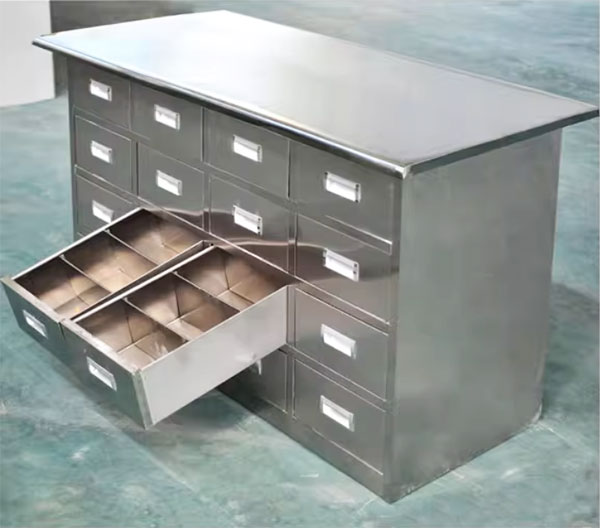
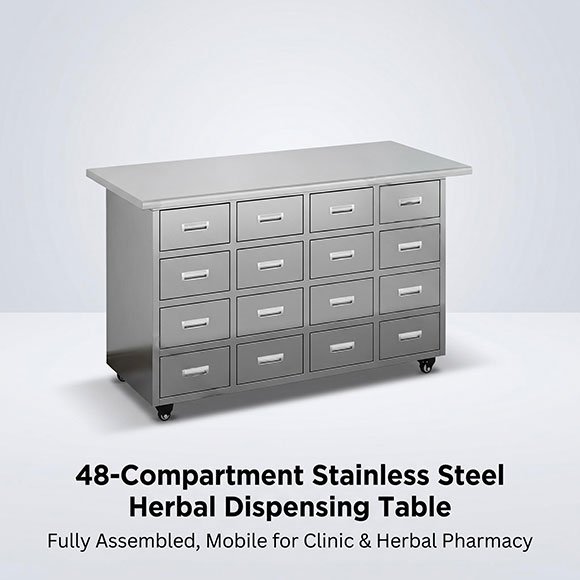
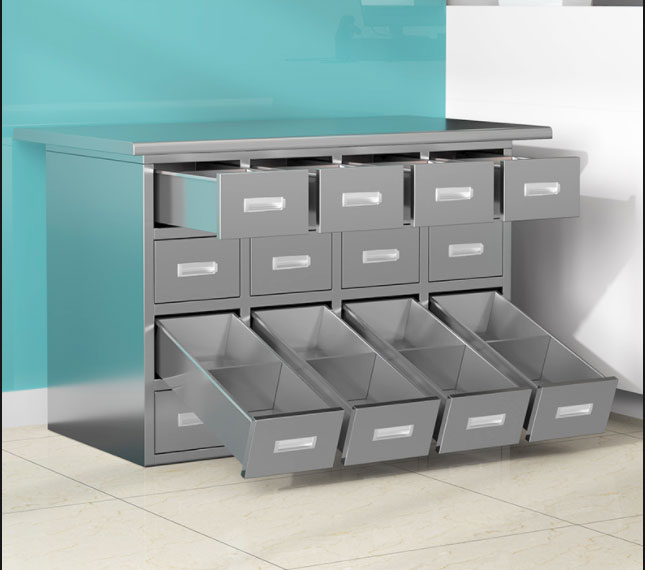
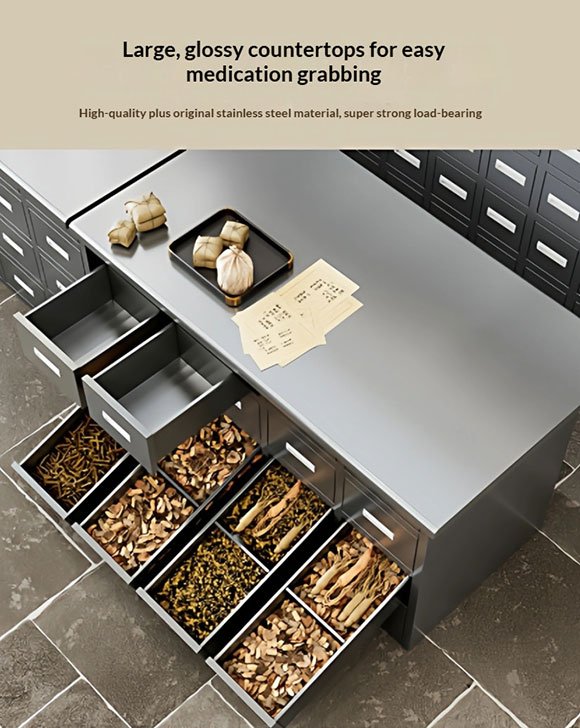
That’s why this cabinet has 3 divided compartments per drawer. The dividers are welded in place — not slotted in. They won’t shift over time. One herb per compartment, open and grab. No digging.16 drawers, 48 herbs total — enough for daily use. Not too many, not too few. You won’t be walking back and forth across the pharmacy.
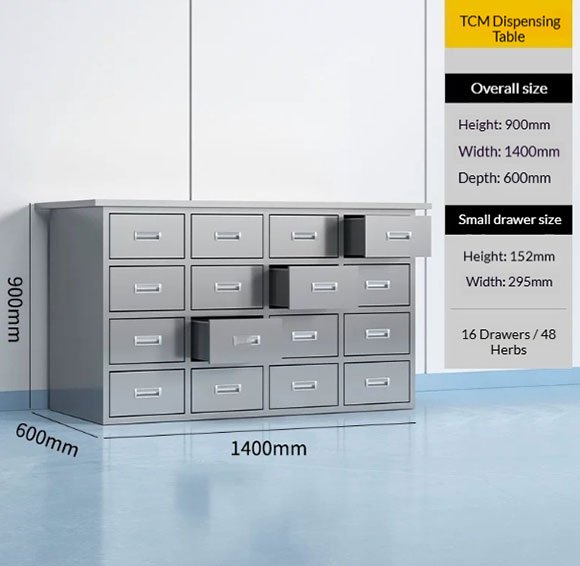
16 Drawer Stainless Steel Herb Cabinet | 48 Herbs Specifications
| Item | Details |
|---|---|
| Material | Type 201 Stainless Steel |
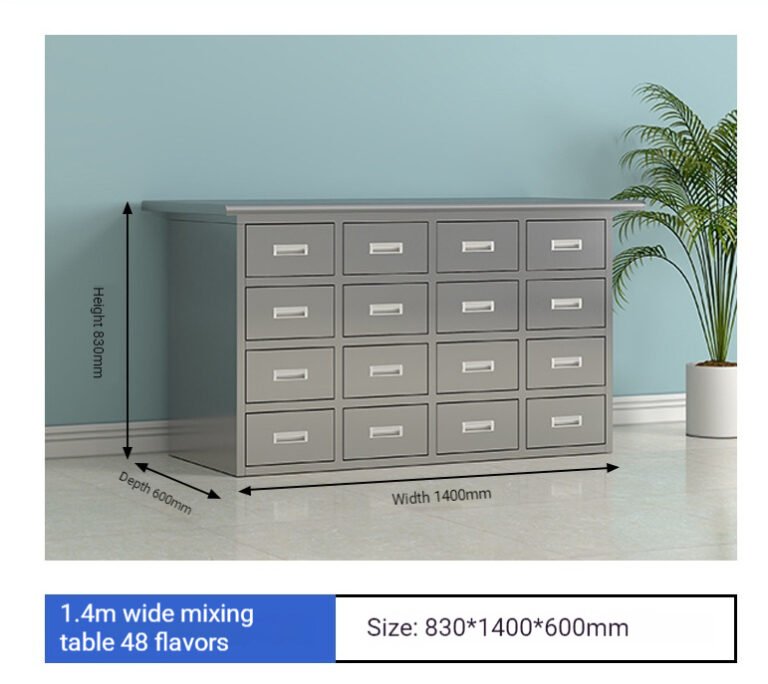
| Overall Size | 1400 (W) × 600 (D) × 830mm (H) — without casters |
| 1400 (W) × 600 (D) × 900mm (H) — with casters | |
| Drawer Interior | 171 (H) × 291 (W) × 485 (D) mm |
| Configuration | 16 drawers, 3 compartments each |
| Total Capacity | 48 herbs |
| Delivery | Fully assembled |
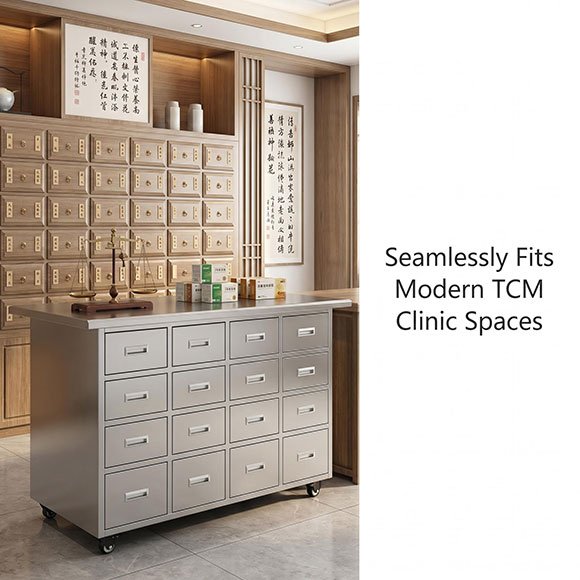
| Casters | Optional (locking swivel casters) |
Drawer depth is 485mm — standard herb bags and storage bins fit without any modification.
How the 3-compartment design came together
We didn’t settle on this layout on the first try. The early drawers were too deep — herbs at the bottom were hard to reach. Then we made them shallower, but couldn’t fit enough per drawer. One herb needed two compartments. That defeated the whole point.
We went through three mold revisions before landing on 485mm with 3 compartments.
The difference from a single-compartment drawer is simple: when everything is in one open space, powders mix. Angelica and codonopsis end up in the same pile. The person picking has to look and separate. With 3 welded dividers, each herb has its own spot. Open the drawer, you know exactly where everything is.
Doesn’t sound like much. But in a busy morning — 40 to 50 prescriptions — saving a few seconds each adds up to real time.
Material: Why Type 201
Three things matter in a herb cabinet: moisture resistance, rust prevention, and odor control. Different materials handle them differently.
Painted sheet metal cabinets cost less. But the paint chips where drawers slide. Once moisture gets in, rust spreads from the damaged spots. Year one looks fine. Year two, the drawers start sticking. It’s not bad manufacturing — it’s the nature of the material.
Wooden cabinets look traditional. But wood absorbs humidity. Drawers swell in wet seasons and the fit changes. In dry climates it’s manageable. In humid regions, drawers start binding after a rainy season. New cabinets also carry paint fumes and potential formaldehyde — you need to air them out before storing herbs.
Type 201 stainless steel doesn’t have any of these issues. The surface is non-porous — herb powder won’t get embedded. A damp cloth wipes it clean. In normal indoor use, 201 is sufficient. If the specification calls for 304, we can supply it — but it costs 30-50% more. For daily clinic use, 201 is the practical choice.
Delivery: Fully assembled
This cabinet ships fully assembled from the factory. Welded, finished, crated. The customer unboxes it and rolls it into position. No screws to tighten, no rails to align, no drawers to install.
KD (knock-down) cabinets are cheaper to ship. But the final assembly quality depends on who puts it together. Screws get cross-threaded. Drawer rails don’t line up perfectly. We’ve been exporting for years, and the feedback we hear most is “I don’t want to build it.”
So we ship it fully assembled. Shipping costs slightly more. Assembly headaches cost zero.
Who this cabinet works for
This 16-drawer, 3-compartment setup fits clinics doing 30-80 prescriptions per day. 48 herbs cover the commonly prescribed range. Not too many drawers — you’re not walking back and forth across the room.
Chain pharmacies use this configuration too — same spec across multiple locations makes bulk ordering simple. Stainless steel holds up well in the high-humidity shipping environment. We sent a container to the Philippines last year. The customer said the fully assembled delivery saved them from finding local help to put everything together.
We also ship regularly to Malaysia, Thailand, and the UAE — mostly Chinese medicine clinics run by overseas practitioners.
FAQs
Q: Is 16 drawers enough?
48 herbs cover most commonly prescribed varieties. If you need more, add a second unit or go with the 20 or 24-drawer model.
Q: Are the drawers smooth?
Every drawer is tested before shipping. Stainless steel slides — they’ll stay smooth for years with normal use.
Q: Do you ship one unit?
Yes. MOQ is 1. Bulk pricing available.
Q: How much is shipping overseas?
Depends on destination. Sea freight to Southeast Asia runs a few hundred RMB per unit. Multi-unit orders bring the per-unit cost down. Export packaging includes moisture-wrap, corner guards, and segmented packing.
Q: Can you customize it?
Yes. OEM orders: silk-screen logo, custom packaging, custom manuals. Locks, label holders, concealed drawers — all available on request.
A note on this particular size
The 16-drawer, 3-compartment size wasn’t pulled from a catalog. We took feedback from early customers — drawers were too deep, dividers weren’t fixed in place. We revised the molds. The current depth and the welded dividers came from testing across dozens of clinics.
If you’re not sure whether this size works for your setup, get in touch. I’ll send you the drawings and real product photos. See if the dimensions fit, see if the look works for your clinic. Then decide.