A few days ago, a customer in Singapore asked me what to look for when buying an herb cabinet for a new clinic. He’d been reading online and found conflicting advice — some said 304 stainless steel or nothing, others said painted sheet metal is fine, and some said more drawers is always better.
I put together what I told him. This isn’t a textbook buying guide. It’s what I’ve learned from selling these cabinets for the past ten years.
New TCM Clinic?Let’s talk size first
Most first-time buyers get stuck on size before anything else.
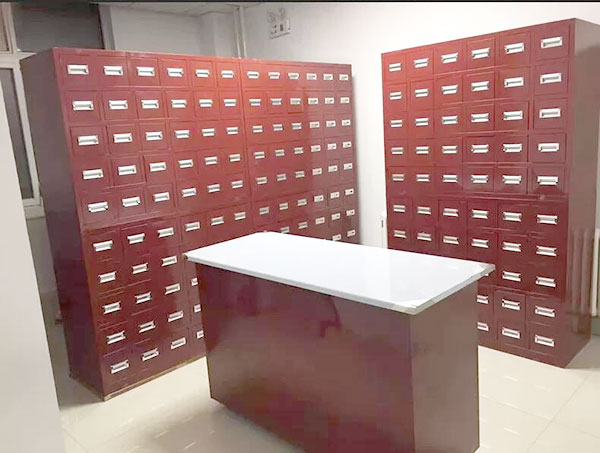
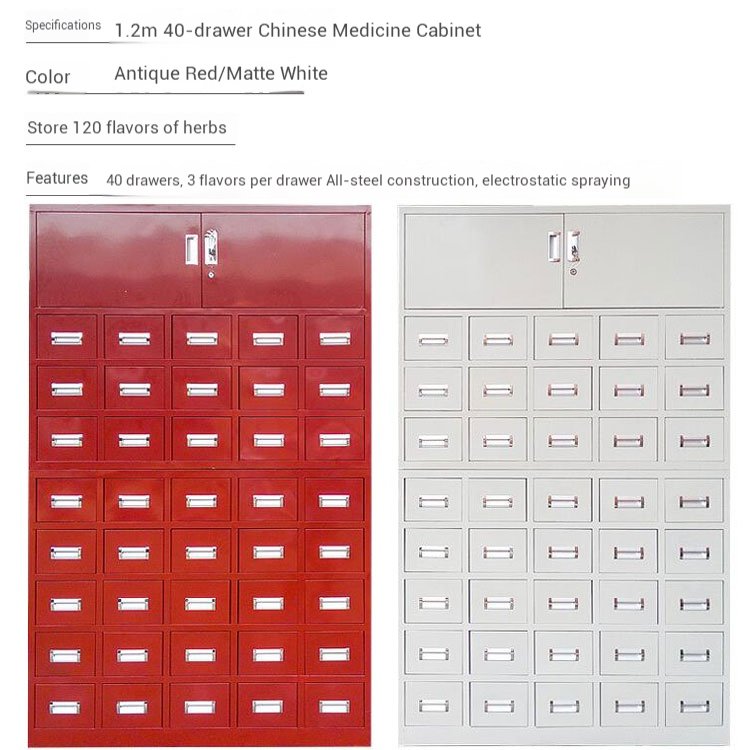
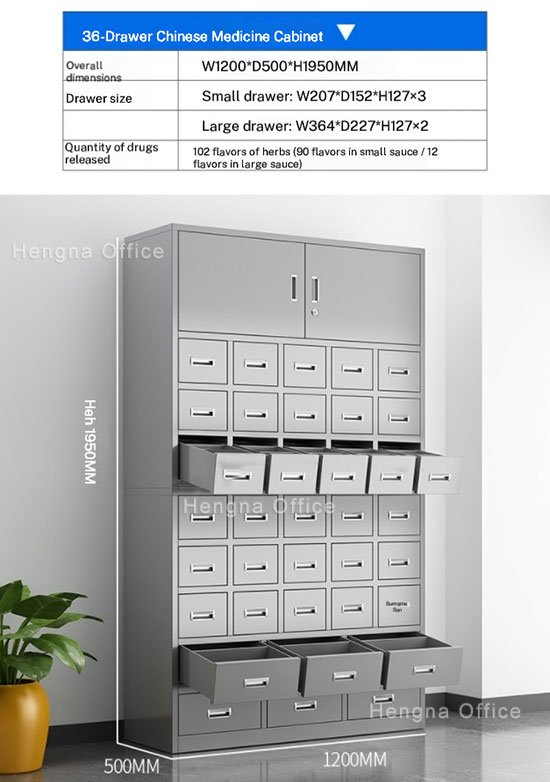
For width, 1400mm is the sweet spot for most clinics. Too narrow and you won’t fit enough herbs. Too wide and it eats into your floor plan. A 1400mm cabinet with 16 or 20 drawers covers the daily herb range for most clinics. If you carry a smaller selection, 1200mm works. If you have space and stock more varieties, go up to 1600mm. But 1400mm is the “won’t regret it” size — it fits standard counter layouts without modification.
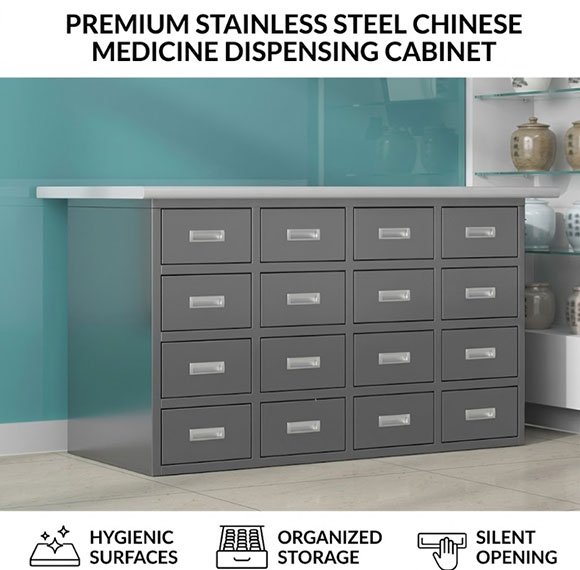
Drawer depth matters more than most people realize. We tested several depths over the years. Too shallow — under 400mm — and you’re refilling constantly. Too deep — over 550mm — and you can’t reach the herbs at the bottom without digging. We settled on 485mm. Standard herb bags and storage bins go in without any adjustment. If you see a cabinet with drawers under 400mm deep, I’d think twice unless space is really tight.
Height depends on whether you want casters. Without casters, standard height is around 830mm. With casters, around 900mm. For a new clinic, I’d suggest getting casters first — move things around until you’re happy with the layout, then you can take them off later if you want.
Choose stainless steel herb cabinet|About materials
Almost everyone who reaches out asks about materials. Here’s what I’ve seen actually happen over the years.
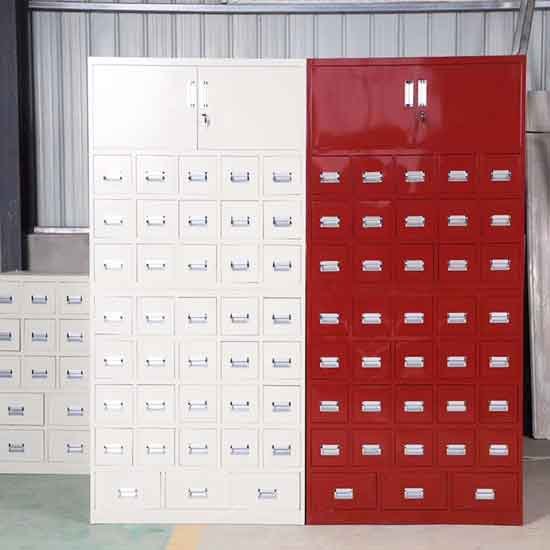
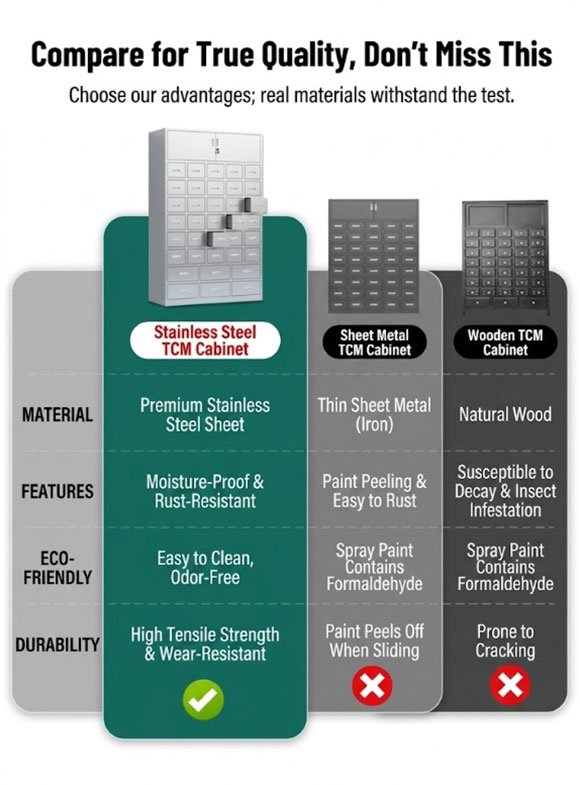
Painted sheet metal cabinets are the cheapest option. But after about a year, the paint starts wearing off where the drawers slide. Once moisture gets in, rust spreads from those spots. Last year a customer sent me a photo of his two-year-old sheet metal cabinet. The drawer frames were rusted stiff. He asked if it could be fixed. I said it could, but he’d be better off switching to stainless steel. It’s not bad manufacturing — it’s just what sheet metal does over time.
Wooden cabinets look traditional and some clinics prefer the aesthetic. But wood absorbs humidity. After one rainy season in a humid climate, drawers start swelling and binding. New cabinets also carry paint fumes — not ideal for herb storage. And once wood gets infested, there’s no fixing it.
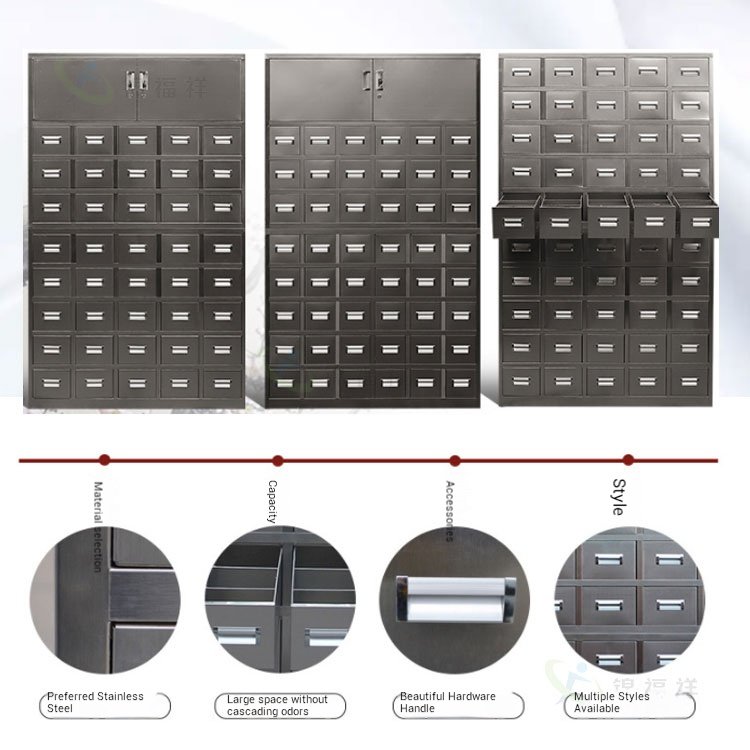
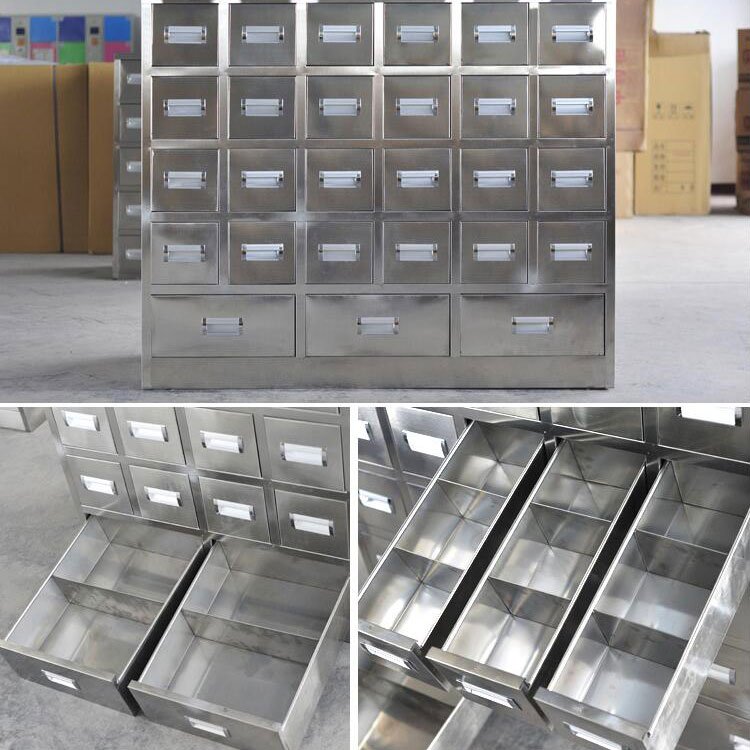
Stainless steel costs more upfront, but you don’t think about it again after that. It won’t rust, swell, or absorb odors. The surface is non-porous — herb powder won’t embed. A damp cloth wipes it clean.
Within stainless steel, there’s Type 201 and Type 304. Type 201 handles normal indoor use just fine. Type 304 has better corrosion resistance but costs 30-50% more. For a clinic counter, Type 201 is the practical choice. Type 304 matters in extreme humidity or chemical exposure — for a standard dispensing table, you’re paying extra for performance you won’t notice.
How to think about budget
The cost of an herb cabinet breaks into three parts: the unit itself, shipping, and installation.
The cabinet: stainless steel costs more than sheet metal but less than solid wood. A 1400mm, 16-drawer stainless steel unit runs in the few-thousand-RMB range from the factory. Sheet metal is cheaper upfront. But spread over lifespan — stainless steel goes 8-10 years, sheet metal starts failing at 2-3 years — stainless steel ends up costing less per year.
Shipping gets overlooked. Fully assembled cabinets cost more to ship than knock-down (KD) ones. But KD cabinets need on-site assembly. For overseas buyers especially, the labor cost to find someone who can assemble it properly often exceeds what you saved on freight. We’ve been exporting for years and the feedback is consistent: customers prefer paying more for shipping and getting a cabinet that’s ready to use out of the box.
So don’t just compare the unit price. Add shipping and installation to the total before deciding which is actually cheaper.
Drawers and compartments
More drawers isn’t automatically better. It depends on your prescription volume.
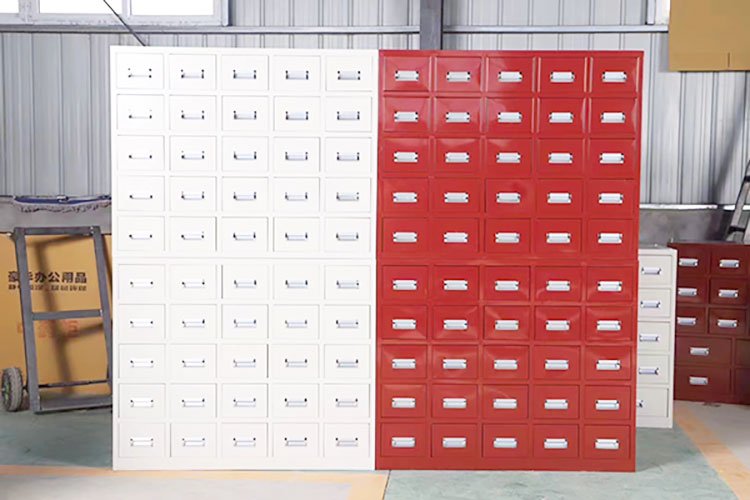
16 drawers (48 herbs) fits clinics doing 30-80 prescriptions daily. 20 drawers (60 herbs) works if you carry a wider variety. 24 drawers (72 herbs) is for large pharmacies or institutions.
One detail that makes a real difference: internal compartment dividers. Single-compartment drawers let different herbs mix in the same space — you end up picking through with your fingers. Three-compartment drawers keep each herb in its own slot. After switching, one customer told me his dispensing speed improved noticeably. Not because the cabinet is high-tech. Because he didn’t have to search through every drawer. A few seconds saved per prescription adds up fast when you’re doing dozens a day.
Things that are easy to overlook
Drawer slides — this part determines how long the cabinet stays smooth. Cheap roller slides start wobbling within a year. Stainless steel slides hold up much longer.
Countertop thickness — you’ll put a scale, herb containers, and packing tools on top. Thin countertops develop a dip over time. A reinforced top costs a little more but stays flat.
Accessories — will you want locks later? Label holders? Concealed compartments? Adding these at the factory costs less than retrofitting. Ask before you buy.
Drawer interchangeability — can you swap two drawers and have them slide smoothly? This is a solid test of build quality. Most cheap cabinets fail this.
FAQs
Q: Is Type 201 really good enough? For normal indoor clinic use, yes. Type 304 is better on paper, but the difference doesn’t show in a standard dispensing environment.
Q: Do you ship one unit? Yes. MOQ is 1. Bulk pricing for larger orders.
Q: How much is shipping overseas? Depends on destination. Sea freight to Southeast Asia runs a few hundred to a thousand RMB per unit. Multi-unit orders lower the per-unit cost.
Q: Can you customize it? Yes. OEM orders: silk-screen logo, custom packaging, custom manuals.
A final thought
Size, material, and budget — you can’t separate them. The right cabinet depends on your space, your climate, and what you’re willing to spend.
If you’re not sure what works for your setup, send me your clinic details. I’ll recommend a configuration that fits.