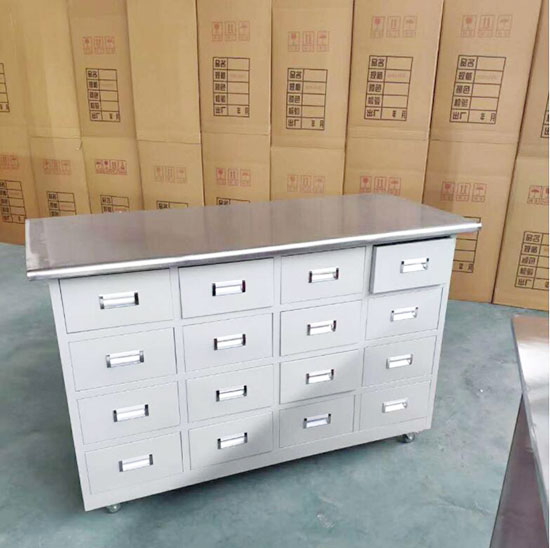
The dispensing counter is the busiest square meter in any herbal pharmacy. Prescriptions are read, weighed, and packed there. Staff turn between it and storage dozens of times an hour. Patients hand over their slips at its edge. A counter that is too low, too small, or covered in seams slows every interaction it touches.
The 16-drawer steel herbal counter is built for that specific spot: a 1.4-meter stainless work surface with 16 organized drawers underneath, engineered for standing-height dispensing in TCM pharmacies and preparation rooms.
Key Features
- 16 organized drawers. Each drawer holds one herb — or one family, split by internal dividers. Powders, roots, barks, and granules each get a sealed home with a labeling slot on the face.
- Steel construction throughout. A cold-rolled steel body carries the daily load of a working pharmacy. No particleboard, no laminate edges that peel, and nothing for moisture to warp.
- Hygienic 201 stainless steel top. The work surface is smooth and non-porous: herb dust brushes off, tincture spills wipe up, and a full disinfectant clean takes under a minute between prescriptions.
- Standing work height. At 90 cm, the surface suits staff who weigh and pack standing — the posture of a busy dispensary, not a bent-over desk job.
- Moisture and dust protection. Sealed steel drawers with labeling slots keep ingredients categorized and protected from the environment at the same time.
Specifications
| Item | Detail |
|---|---|
| Material | Cold-rolled steel body + 201 stainless steel worktop |
| Dimensions | 140 cm (L) × 90 cm (H) × 60 cm (D) |
| Drawer count | 16 drawers with labeling slots |
| Color | Burgundy red standard, custom options available |
| Usage | Herbal medicine preparation, ingredient storage, dispensing |
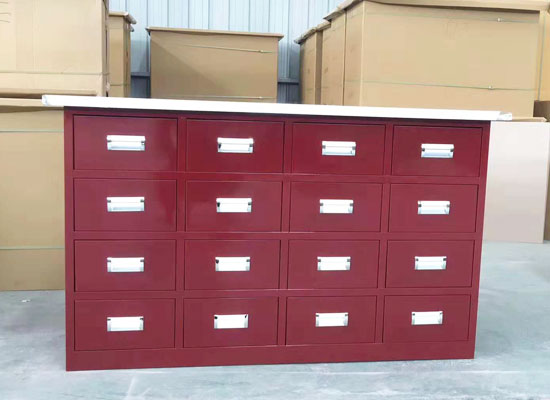
Why the One-Piece Stainless Top Matters
The title calls it a one-piece top, and the detail is worth explaining because it decides how the counter ages. Cheaper units ship with laminated boards or several joined sheet panels. Every seam is a trap:
- Herb dust settles into joints and cannot be wiped out
- Liquid spills wick into the seam and stain permanently
- Laminated edges peel after a year of wet wiping
A single 201 stainless sheet has no seams to trap anything. The surface stays flat, wipes clean in one pass, and tolerates the disinfectants modern pharmacies use daily. After five years of service, a one-piece stainless top looks the way it did on delivery day.
Planning a Dispensing Layout Around the Counter
The counter works best when the room works around it. Three layout principles come up again and again with dispensary managers:
- Drawers face the work flow. Staff stand behind the counter, patients at the front. The drawer faces point at the dispenser, not the patient — so refills and weighing happen on the same side as the scales.
- Keep the scale on the top. A permanent scale position at one end, packing paper beside it, turns the surface into a fixed production line instead of a cleared-off desk each morning.
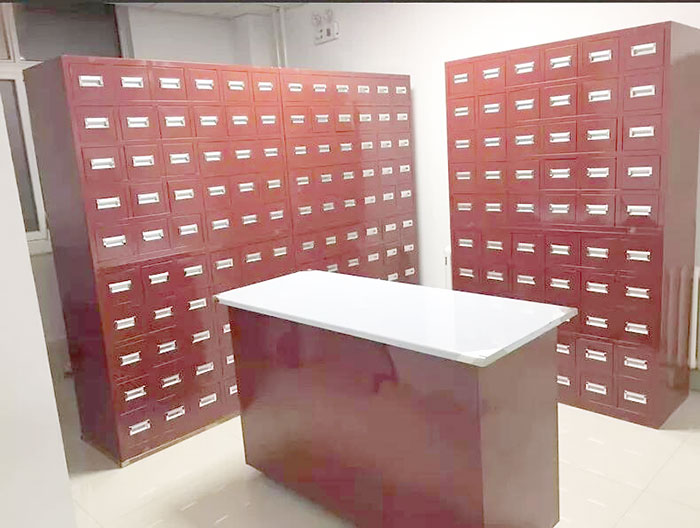
- Pair with a tall cabinet for volume. The 16 drawers cover daily-use herbs; a wall cabinet behind handles the bulk stock. Pharmacies that try to run everything through the counter alone run out of room within months.
Fitting the Counter into a Small Room
The counter’s 1.4-meter length fits most dispensing walls, but a few measurements make the difference between a smooth install and a squeezed one:
- Wall run. The counter needs 1.4 m of clear wall; add 10 cm breathing room at each end for cleaning access.
- Standing aisle. Leave at least 90 cm between the counter’s front edge and whatever faces it — staff stand, reach down into drawers, and step back with trays in hand.
- Door swing. Check that the room door and the counter’s position do not fight; a door that sweeps across the working aisle slows every entry.
- Delivery path. Measure corridors and doorways to the room. The counter ships as a one-piece welded unit — measure twice, order once.
For rooms tighter than 1.4 m allows, the same design exists in shorter widths — worth asking about before compromising on drawer count.
Who Uses This Counter
- TCM clinics. Practitioners who prepare and dispense on-site need weighing space and storage in the same footprint — this counter is that footprint.
- Retail herbal pharmacies. The stainless top doubles as the sales counter; the drawers keep the loose-stock dispensing zone tidy behind it.
- Wellness centers. Herbal tea blends, compress packs, and bath preparations each get a clean, dedicated preparation surface.
- Teaching spaces. Student dispensaries use the counter to practice weighing and identification at real working height.
Counter-First vs Cabinet-Only Setups
| Setup | Strengths | Limitations |
|---|---|---|
| Cabinet only | Maximum storage per square meter | No work surface — weighing happens elsewhere or on top of the cabinet |
| This 16-drawer counter | Prep surface + daily storage in one unit; standing work height | 16 drawers cover a focused herb list, not a 300-herb inventory |
| Counter + wall cabinets | Full dispensing operation in a small room | Requires layout planning and matching finishes |
For a new clinic or a renovation, the third option is the standard answer: a counter as the work hub, wall cabinets behind for volume.
Care and Longevity
- Wipe the stainless top after each batch — dry cloth for dust, damp cloth for residue.
- Disinfect daily with a mild solution; stainless does not dull or stain.
- Use food-grade paper liners in powder drawers for fast changes between herbs.
- Check the drawer slides twice a year — ball-bearing slides last a decade-plus with simple dusting.
With this routine, owners report the counter’s structure and finish holding up well past its first decade of daily service.
FAQ
What is the difference between this counter and a regular worktable?
A regular table gives you one surface. This counter adds 16 sealed, labeled drawers underneath — the storage your dispensing actually needs — at the height your staff actually works.
Can the counter hold a decoction machine or electric dispenser?
The steel frame carries normal equipment loads. For permanently mounted heavy machines, confirm the intended use with the supplier before ordering.
Is a version with wheels available?
Yes, caster versions are made for pharmacies that reposition for cleaning or operate from different rooms. Brakes hold the counter steady during weighing.
Can I order it in a different color or width?
Yes. Burgundy red is the standard finish; custom colors, widths, and drawer configurations are available on OEM orders.
How does this counter protect herbs?
Sealed steel drawers block moisture, dust, and pests, and steel does not absorb herb oils or odors — so each batch keeps its own character.
How does it compare with the dual-use herb table on this site?
Both are 16-drawer steel units with a 201 stainless top and the same footprint. The differences are in finish options and ordering details — tell the supplier your room and workflow, and they will point you to the right one. Functionally, both serve the same dispensing role.
Build the Dispensing Hub
Herbal dispensing runs on repetition: same motions, same positions, all day. Give those motions a counter built for them — one-piece stainless surface, 16 labeled drawers at arm’s reach, standing work height — and the daily routine becomes noticeably smoother from week one. That is what this counter is designed to do, and what it keeps doing for years after the first prescription crosses its surface.
See the full range of steel herbal dispensing counters, and if you need a taller storage companion, browse stainless steel herbal cabinets.