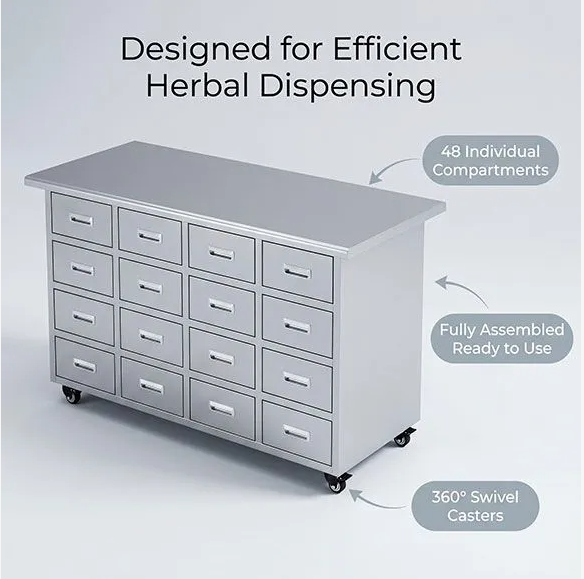
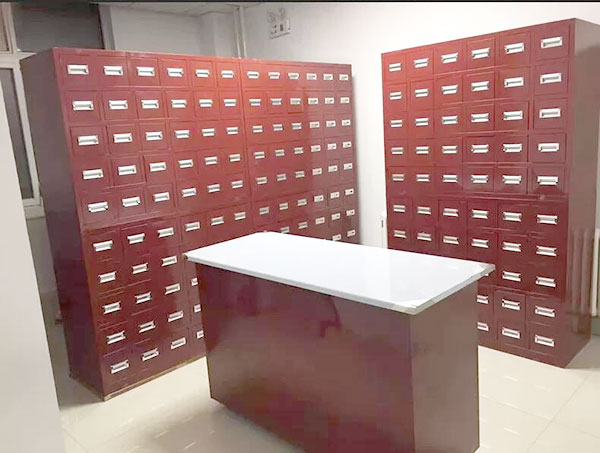
Pull open a drawer in your herb cabinet, reaching for the Gan Cao. There it is. A small pile of sawdust in the corner. Again. Third time. You replaced these wooden cabinets last year—spent close to $5,000. Now termites have eaten through the bottom of one drawer and the back of two more. The herbs go in the trash. The clinic closes for half a day. You call the carpenter. Again.
If your pharmacy sits in Southeast Asia, South Asia, coastal Latin America, or anywhere humidity stays above 60% most months, you have probably lived through a version of this. The question is not whether termites will attack wooden cabinets—it is when.
Why Wood Cabinets Fail in Tropical Pharmacies
Wood and herbal medicine share a fatal weakness: both hate moisture. When ambient humidity crosses 70%—normal for Manila, Mumbai, Ho Chi Minh City, Dar es Salaam—wood moisture content hits 18% to 22%. At that level you get three problems at once: the wood swells and seizes the drawer runners; fungi start growing in the grain; and termites—which reproduce twice as fast above 65% humidity and 25°C—find an all-you-can-eat buffet. You open the clinic doors every morning. You open them for the termites too.
A clinic owner in Ho Chi Minh City installed a set of oak 48-drawer cabinets in May 2023. By September 2024 he could not pull the drawers open—humidity had swollen the wood until every rail seized. Termites entered through a hairline crack in the back wall. By the time he found them, the bottom 12 drawers had hollowed-out bases. He repaired the cabinets three times. Then he threw them out. His current cabinets? 201 stainless steel. Two years, zero issues.
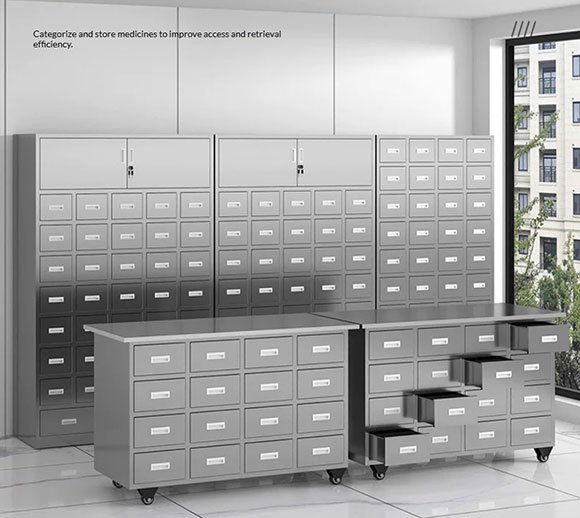
Steel vs Wood: What Actually Matters Day to Day
Termites and pests. Wood offers termites food and shelter. Stainless steel and powder-coated steel offer them nothing. This is not “termite-resistant” in the way a chemical spray is—it is termite-irrelevant. The insect has zero reason to approach. That distinction matters when your pharmacy stores thousands of dollars of inventory.
Humidity and swelling. A wood cabinet in 90% humidity swells until drawers bind shut. A steel cabinet with ball-bearing drawer slides operates the same at 40% humidity and 95% humidity. 201-grade stainless handles routine moisture; 304-grade adds salt-corrosion resistance for pharmacies near the ocean.
Cleanability. Herb powder, root fragments, and dust settle into wood grain and between boards. Add humidity, and those crevices become mold farms. A steel cabinet wipes clean with alcohol or disinfectant. Most clinics sanitize twice weekly—you can scrub powder-coated steel without stripping finish. Try that on lacquered oak.
Actual lifespan. A high-quality hardwood cabinet in a dry climate lasts 8 to 10 years. In the tropics, budget for 3 to 5. A steel herbal cabinet is built for 15-plus years. The Ho Chi Minh City clinic owner’s stainless steel cabinets came with a 10-year factory warranty.
The Real Cost: Wood Looks Cheaper Until You Do 10-Year Math
A custom solid-wood 48-drawer cabinet runs $1,000 to $1,500 at factory price. Export to Southeast Asia adds 50% to 80% for freight and duties. Stainless steel equivalent: 30% to 50% more upfront. The sticker price favors wood—until you calculate 10 years. Replace wood every 3 years in the tropics, that is three cabinets over a decade. Three installations. Three disposals. Three rounds of clinic downtime. Steel: buy once, done. Total cost: 1.8 to 2.5 times the steel option in the long run.
A pharmacy in Surabaya, Indonesia learned this the expensive way. Termites chewed through a back panel of a wooden herb cabinet, then migrated into an adjacent display case—straight into 150 kilograms of dried Lingzhi slices. Everything wrecked. The owner told me later: paying an extra thousand dollars for steel would have saved the entire Lingzhi batch. The single loss was larger than the wood-vs-steel price gap ten times over.
201 vs 304 Stainless Steel: Which One for Your Clinic?
201 stainless contains 3.5% to 5.5% nickel. It handles everyday moisture, wipes clean without rusting, and costs less. Perfect for inland humid cities like Bangkok, Kuala Lumpur, or inland Central America.
304 stainless contains 8%+ nickel. It resists salt corrosion—essential if your pharmacy is within a few kilometers of the ocean: Manila, Ho Chi Minh City, Rio de Janeiro, Lagos, Dar es Salaam. The price difference between 201 and 304 for a 48-drawer cabinet is roughly $200 to $400. If you are near salt water, spend the extra. If not, put the savings toward a decoction machine.
Who Should Switch—and Who Can Wait
Switch now if: your pharmacy is in a tropical, subtropical, or coastal zone. You have already replaced wooden cabinets once. A patient has mentioned a musty smell. You store high-value inventory—Lingzhi, Cordyceps, aged Chen Pi—where one pest hit is a five-figure loss.
Wait if: you are in a dry climate, your HVAC keeps humidity under 50% year-round, and your current cabinets are less than a year old.
Do not switch if: your clinic is in a temperate dry zone and your routine works. But when it is time to order replacements—do not order wood.
Common Questions from Pharmacy Owners
Do steel cabinets look too industrial for a TCM clinic?
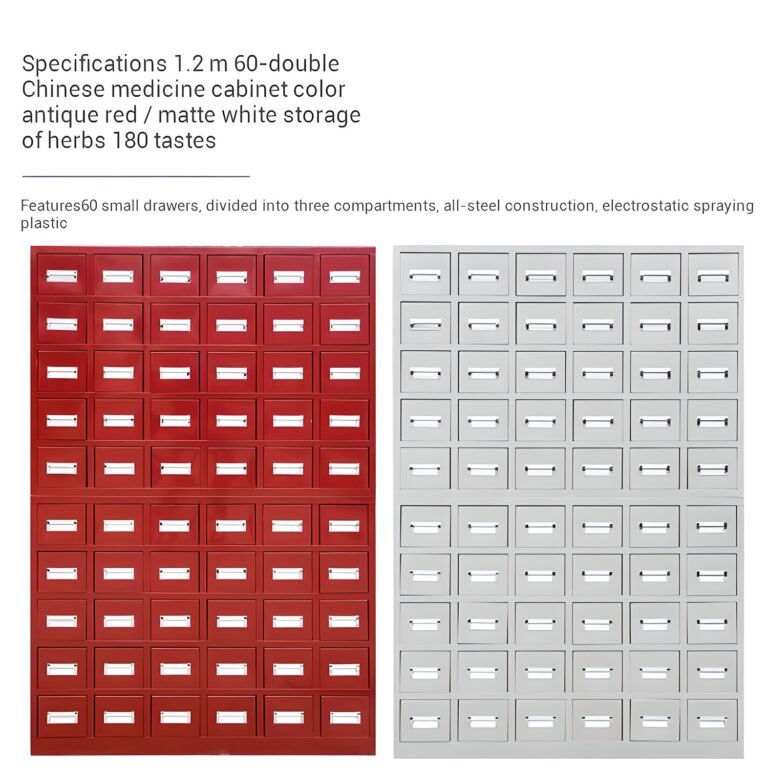
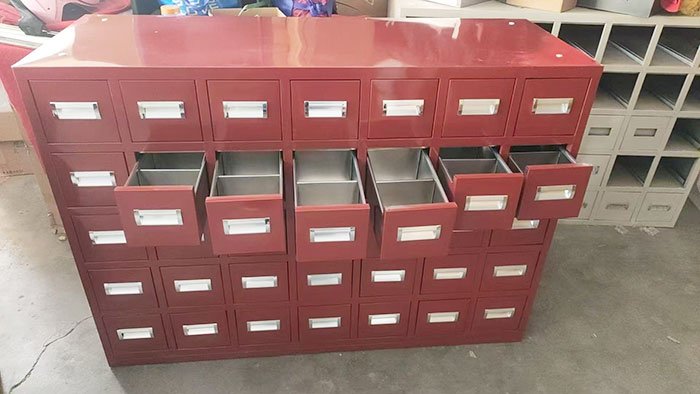
Not anymore. Modern powder coating comes in wine red, warm white, or wood-grain texture. Many premium TCM practices choose metal intentionally—it signals clean, modern, and compliant. It says “serious medical facility.”
How heavy are steel cabinets? Do I need reinforced floors?
A 48-drawer 1.2m-wide steel cabinet weighs 120 to 150 kg. A wooden equivalent weighs 80 to 100 kg. The 40 kg difference is not structural for any commercial building. If your clinic is upstairs, plan for two-person carrying instead of one.
Will the drawers scratch over time?
They can—everything scratches. But powder coating is harder than wood lacquer. More importantly, scratches on colored powder coat stay the same color underneath. Scratches on wood expose lighter raw material and look worse the deeper they go.
Where can I buy steel herbal cabinets factory-direct with worldwide shipping?
Luoyang Hengna manufactures steel and stainless steel TCM cabinets in Luoyang, Henan, China—part of a major industrial furniture cluster. We ship to Southeast Asia, the Middle East, Africa, Europe, and the Americas. Cabinets range from 16-drawer to 72-drawer configurations, with OEM options for labeling, color matching, and compartment sizing. MOQ starts at 1 unit for standard models. Request a quote with your drawer count and location—we will confirm stock and shipping within one business day.
Termites do not send warnings. They leave sawdust in your drawer and let you connect the dots. You can keep replacing wood cabinets every three years. Or you can buy steel once and get back to the work that actually matters—treating your patients.
Explore more: